Genius Loci
The Spirit of Place in Celtic Landscapes

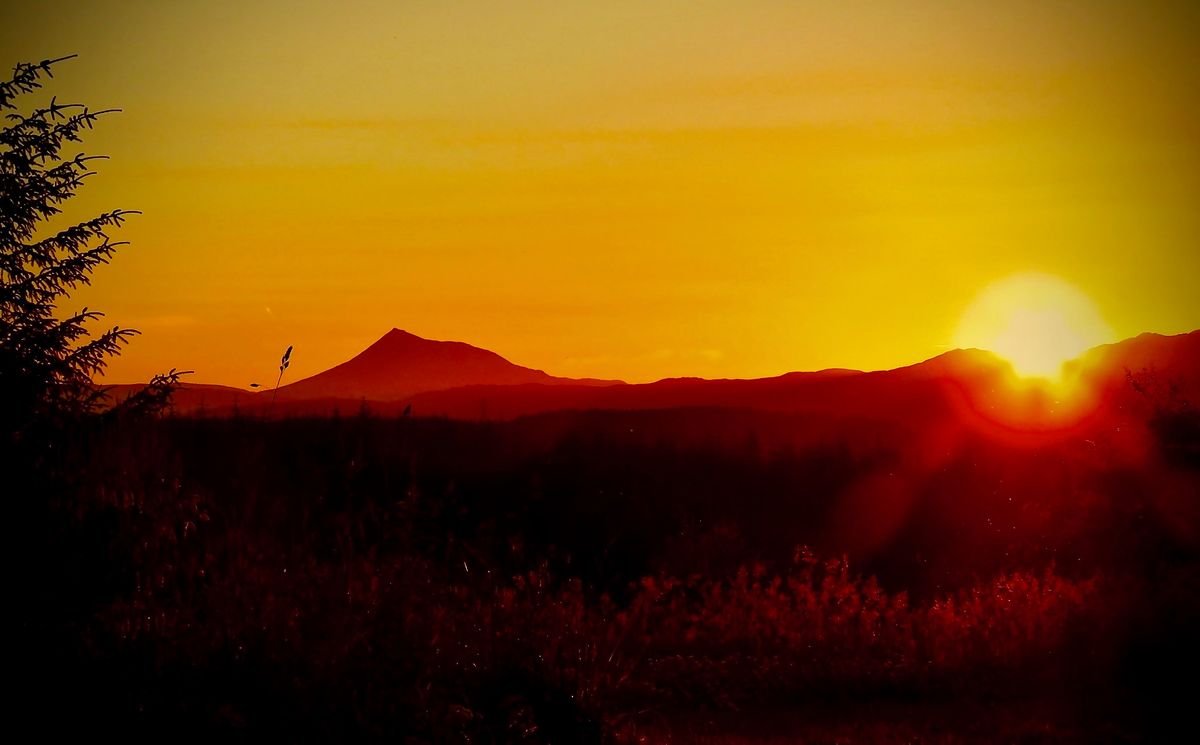
Schiehallion is one of Scotland’s most popular Munros. Its name in Gaelic - Sìdh Chailleann - translates to ‘Fairy Hill of the Caledonians’.
There are places we visit and places that appear, in some indefinable fashion, to receive us. The difference is not always visible on a map.
When a place has a presence
Some places possess a character that resists easy description. A beechwood changes as the last of the afternoon sun vanishes among its trunks. A burn emerges from under the roots of a wind-thrown tree and runs into a little pool as black as peat. On a bare hillside, a single stone stands against the sky. There may be no discernible reason to stop, and yet we do.
Our awareness alters. The noise of ordinary thought recedes. We notice the sound of a wingbeat, the dampness of the earth, the way the wind has fallen away beneath a sheltered bank. There may be comfort in the experience, or an unaccountable sense of being watched. A naturalist might call it heightened attention; someone whose spirituality is animistic might say that the place has made itself known.
Genius loci gives us a language for considering such encounters. Its original Roman meaning was the protective spirit of a particular locality. In later usage, it can mean the distinctive atmosphere of a place. The religious guardian and the felt character of a landscape are related ideas, but they are not identical. At Carrawburgh, beside Hadrian’s Wall, a Roman shrine dedicated to water nymphs and the genius loci stood around a well. Nearby, offerings honoured Coventina, a named water goddess whose identity should not be dissolved into a general category of nature spirits.
The recognition of sacred presence in particular places is widespread, without being one universal religion. In Japan, Mount Fuji has accumulated religious meanings and pilgrimage routes over centuries; in Nigeria, the Osun-Osogbo grove remains a place of worship connected with the river goddess Osun. These are distinct histories and living relationships, not copies of Roman belief. Their resemblance lies in the recognition that somewhere may be approached with obligations as well as expectations.
That thought leads us towards the Atlantic landscapes of Scotland, Ireland, Wales, Cornwall and Brittany. Here water, woodland, stone and local speech bring the spirit of place close to the path beneath our feet.
Reading the Celtic landscape
There was no single, timeless Celtic religion shared unchanged across these lands. Nor were their prehistoric monuments necessarily built by people whom we can identify as Celtic-speaking. We encounter several histories together: Neolithic and Bronze Age communities; later pre-Christian beliefs; medieval Christian devotion; recorded folklore; and modern Pagan, Druidic and Wiccan practice.
A place may gather meanings from more than one of these histories. Its spring can have a geological source, a saint’s dedication, a healing reputation and a new significance for a contemporary Pagan visitor. Such associations need not cancel one another. Neither do they prove that the same ceremony has been performed continuously since prehistory.
The distinction matters particularly at standing stones. A megalith is a monument constructed with large stones; the term includes different kinds of standing-stone settings and tombs. Burial evidence may establish one purpose. An astronomical alignment may establish another relationship. Neither automatically identifies the builders’ gods or permits us to call the site a Druidic sanctuary. At Calanais, Newgrange, Bryn Celli Ddu and Carnac, the archaeological histories reach back into the Neolithic, long before the surviving classical accounts of Druids.
Yet later associations also belong to the place. Folklore tells us how people interpreted the old stones, feared a hollow hill, visited a spring or explained a name. A story collected in the nineteenth century is evidence that the story was told then; its setting in an ancient landscape does not date its origin. We lose little wonder by remembering this. We gain a clearer sense of the many lives a place has held.
Druidry and the sacred grove
The grove occupies a privileged place in the Druidic imagination. Pliny describes the religious importance of oak and mistletoe among Druids in Gaul. Tacitus, writing of the Roman assault on Mona, now Anglesey, describes Druids and the destruction of groves. These are ancient witnesses, but they are outsiders’ accounts, shaped by Roman interests and literary purposes. They offer fragments rather than a complete handbook of belief.
Modern Druidry draws upon ancient testimony, Welsh and Irish literature, later revival movements and contemporary experience of nature. Its relationship with the past is one of study, inspiration and creative renewal. Present-day practice can be meaningful without claiming an uninterrupted institutional descent from the Iron Age.
In a Druidic approach to genius loci, a grove is more than an outdoor meeting room. Its living inhabitants participate in the occasion. The trees alter the light; insects move in the undergrowth; weather arrives uninvited. The walker might pause at the edge, acknowledge the place and seek awen, the inspiration associated with Welsh bardic language and modern Druidic practice. This is a contemporary spiritual response, not a reconstructed ceremony certified by archaeology.
The relationship may be slow. A wood visited through the seasons can become familiar through changes too slight to register on a single walk. The spirit of place need not be expected to announce itself. Attention is already a beginning.
Nemeton
Nemeton, with the plural nemeta, is a Celtic term for a sanctuary or sacred space, often understood as a sacred grove or woodland clearing. The association is supported by ancient names and religious inscriptions, rather than merely by modern enthusiasm for trees. The Romano-British dedication to Mars Rigonemetis at Nettleham, outside the five regions considered here, provides a useful linguistic comparison: its Celtic title is interpreted as king of the sacred grove.
Scotland contains at least 26 identified place names linked to nemeton.
In Brittany, the name Névet, associated with the woodland near Locronan, is linked with this word. The name offers a particularly evocative meeting of language, woodland and sacred geography. It does not, by itself, identify the ceremonies once performed there or demonstrate that today’s procession follows an unchanged Druidic rite.
For a modern Druid, calling a place a nemeton may express the intention to honour it as sacred. That use should be distinguished from identifying an ancient sanctuary through evidence. A shaded clearing may invite the name, but its beauty is not an archaeological diagnosis.
Scotland
The Scottish landscape holds its supernatural associations in burns, lochs, glens and knolls. Gaelic fairy tradition speaks of the sìthichean, beings whose dealings with people could be perilous as well as generous. The fairy hill suggests that the visible world has neighbours: a grassy rise may conceal a dwelling whose inhabitants have claims upon it. Recorded traditions are varied; they do not make every hill a fairy mound.
The Cailleach brings another presence into the landscape. In Scottish and Irish folklore she can be associated with weather, winter and the shaping of land. Beinn na Caillich on Skye is an example of a name translated as the hill of the old woman. Yet cailleach is also an ordinary word with several contexts: its appearance in a name does not always identify a goddess. The local story and the recorded forms of the name must be heard together.
At Calanais on Lewis, great stones stand within a landscape of water and open sky. Excavation places the main circle between about 2900 and 2600 BC. Later folklore described the stones as giants transformed after refusing Christianity. The story belongs to the stones’ cultural life; it is not an account of their Neolithic construction.
On the Black Isle, Munlochy Clootie Well remains a place where cloth is tied to trees, in the belief that illness will fade as the rag decays. At the separate Culloden well, rag offerings were recorded in the mid-nineteenth century. This is firm evidence of a documented custom, without establishing its prehistoric origin.
Beside such a well, the walker meets both the hope expressed by an offering and the living tree bearing it. A spiritual reading of the place should remain attentive to both.
Ireland
In Ireland, place and story are intimately joined. The medieval dindshenchas, or lore of places, explains names through narratives of people, extraordinary events and sacred associations. These works preserve a literary landscape, not a transparent transcript of prehistoric religion. They show how a river or hill could become a store of remembered meaning.
At Newgrange in the Boyne valley, a passage tomb built around 3200 BC admits the rising midwinter sun through its roof-box. The physical alignment is evidence; the complete theology of its builders remains beyond us. Today’s solstice gatherings and the public lottery for access to the chamber are living responses to an ancient monument, with their own modern history.
Myth gives Brú na Bóinne another kind of inhabitant: Oengus Óg, associated with youth and love. In The Dream of Oengus, he and Caer take swan form and return to Brú together. A named divine presence makes the place more than an anonymous mound. This is a later literary association, rather than evidence that the Neolithic builders worshipped Oengus.
The more intimate sacred landscape lies beside lanes and fields. Holy-well traditions include prayers, prescribed rounds and visits on a patron saint’s day, often called a pattern day. St Brigid’s Well at Liscannor in County Clare holds devotional offerings within its well-house. Irish rag-tree customs are also documented, although their forms and meanings vary by place. Christian prayer and local healing lore may meet here without either being adequately described as disguised Druidry.
Names help the walker notice what might otherwise pass unseen. Irish tobar means a well or spring; Tobar Feichín, also known as Toberfeheen Holy Well in County Galway, joins water to a saint’s name. Tobar Dé in County Wicklow is also known as Holywell. These names direct enquiry towards particular histories. The word for water alone is not proof of worship.
What matters is the local relationship: who tends the well, which story accompanies it, and whether people still visit. A small spring known to one family may carry more living significance than a celebrated ruin.
Wales
Anglesey brings Druidic history and much older monuments into close geographical company. Tacitus’s account of Mona belongs to the first-century Roman conquest. Bryn Celli Ddu belongs to the Neolithic. Their presence on the same island does not make the tomb a documented work of Druids.
Bryn Celli Ddu means mound in the dark grove. The site developed from a henge and stone circle into a passage tomb; its passage receives the midsummer sunrise. For the walker, name, woodland imagery and light offer a powerful invitation to reflection. The name’s evocative meaning does not date it to the construction of the monument.
At Holywell, St Winefride’s Well expresses a different sacred history. Pilgrimage is recorded there from at least 1115, and the surviving chapel dates to the late fifteenth century. Pilgrims still bathe in the waters in the hope of healing. Contemporary worship belongs to a Christian shrine. To appreciate its water through an animist or Pagan lens is a visitor’s interpretation, rather than evidence that its custodians are practising an older religion unknowingly.
Wales also gives Druidic imagery a prominent cultural life. Gorsedd Cymru, established by Iolo Morganwg in 1792, is associated with the National Eisteddfod and honours contributions to Welsh language and culture. Its ceremonial presence is part of a documented revival history, not proof of an unchanged ancient priesthood.
The spirit of place here can be heard as well as seen: in a Welsh name retained, a poem spoken and the local memory of a spring. Landscape includes the language through which people have learned to know it.
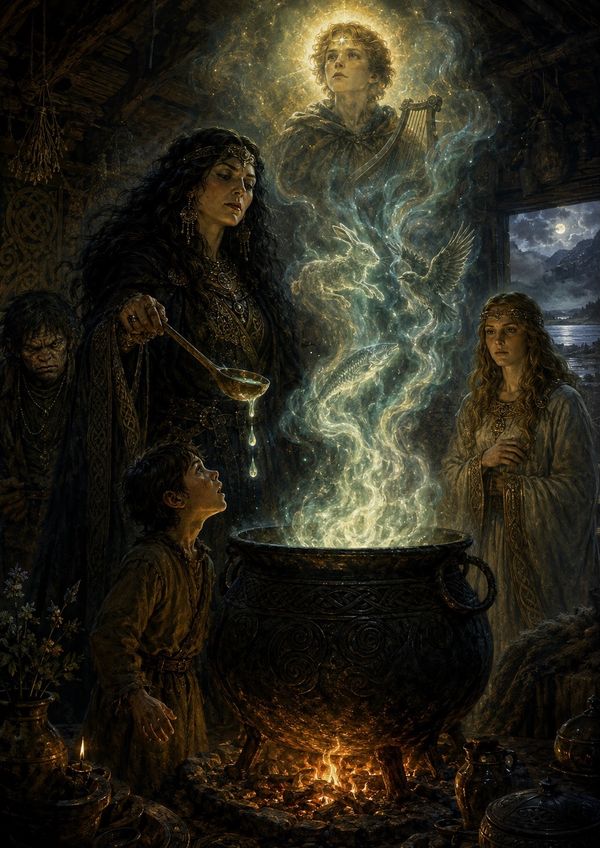
The tale of Cerridwen’s cauldron adds transformation to that imaginative world. Gwion Bach obtains its inspiration and is eventually reborn as Taliesin. Modern Druids may read the story as a meditation on awen, change and poetic discovery. The surviving literary tale provides inspiration; it does not locate a proven ancient ritual beside whichever Welsh pool happens to stir the visitor’s imagination.
Cornwall
In Cornwall, stone and water repeatedly draw folklore towards particular ground. Near the Merry Maidens stands the entrance grave at Tregiffian, dated to the Neolithic or early Bronze Age. The circle’s name, Dans Maen, means the stone dance. Such a name gives the setting a narrative movement, while the archaeological record keeps its separate chronology.
Madron Well offers unusually helpful evidence for the changing life of a healing place. Reports of healing date from around the turn of the seventeenth century; later accounts describe divination, while present-day visitors leave offerings or come to contemplate. Cloth on branches belongs to that living setting. The records allow us to speak of historical healing and wishing customs; they do not establish an uninterrupted rite from the age of the monument builders.
The atmosphere is inseparable from the physical hollow: wet ground, leaves, a spring partly concealed. A visitor may sense a guardian presence, or regard the place as a meeting of human longing and natural water. Neither reading requires the other to disappear. The actual history is already strange enough to deserve patience.
Cornwall also has a modern public life of witchcraft and magic. The Museum of Witchcraft and Magic at Boscastle has its own founding history, while Gerald Gardner was associated with an earlier museum on the Isle of Man. The connection reminds us that modern Wicca, folk magic and local well traditions have intersecting but distinct histories. They cannot simply be gathered into a single ancient Cornish religion.
Brittany
Brittany’s sacred landscape is on a monumental scale at Carnac and along the shores of Morbihan. The megalithic structures of this wider landscape date to approximately 5000–2300 BC. Their placement relates to terrain, waterways and one another, but many questions about their meanings remain open. These are works of Neolithic communities, not securely attributable to the Druids of later accounts.
The grove returns at Névet near Locronan. Here the linguistic association with nemeton stands beside the living devotion to Saint Ronan expressed in the Grande Troménie. This procession is a present encounter with a storied landscape. It is tempting to imagine one unchanged sacred circuit surviving every change of religion, but that would exceed the evidence supplied by the name.
Breton pardons are patronal celebrations centred on churches and chapels, frequently including a procession to a fountain for a blessing. They emerged within medieval popular piety and continue as communal occasions. Volunteers, parishioners, music and shared meals sustain them; they also adapt as communities change.
They belong in an essay on genius loci because devotion attaches to named places, local saints and particular water. They should be recognised as Christian celebrations in their own right, even where other spiritual interpretations gather around them.
For the walker, Brittany’s ancient stone settings, woodland names and fountain festivals offer different ways of encountering sacred ground. Their power lies partly in their differences. The same countryside can hold the remains of a remote symbolic world and a celebration still prepared by neighbours.
Breton supernatural storytelling gives the woods other inhabitants too. Korrigans, the little people of local legend, remain part of the region’s contemporary storytelling, while Brocéliande at Paimpont is associated with Arthurian figures and the fountain of Barenton. These are living imaginative associations, also renewed through guided walks and tourism. Their present popularity should not be mistaken for proof of an unchanged prehistoric cult.
Holy wells and clootie wells
A holy well is a spring or well to which a community attributes sacred, devotional or healing significance. Its water may be ancient in a geological sense; its masonry, name and recorded religious use may be much later. A clootie well is a more specific kind of ritual setting associated with cloth offerings. Cloot is Scots for a rag or piece of cloth; rag-well and rag-tree customs are documented in Ireland and Cornwall as well as Scotland. Not every holy well is a clootie well.
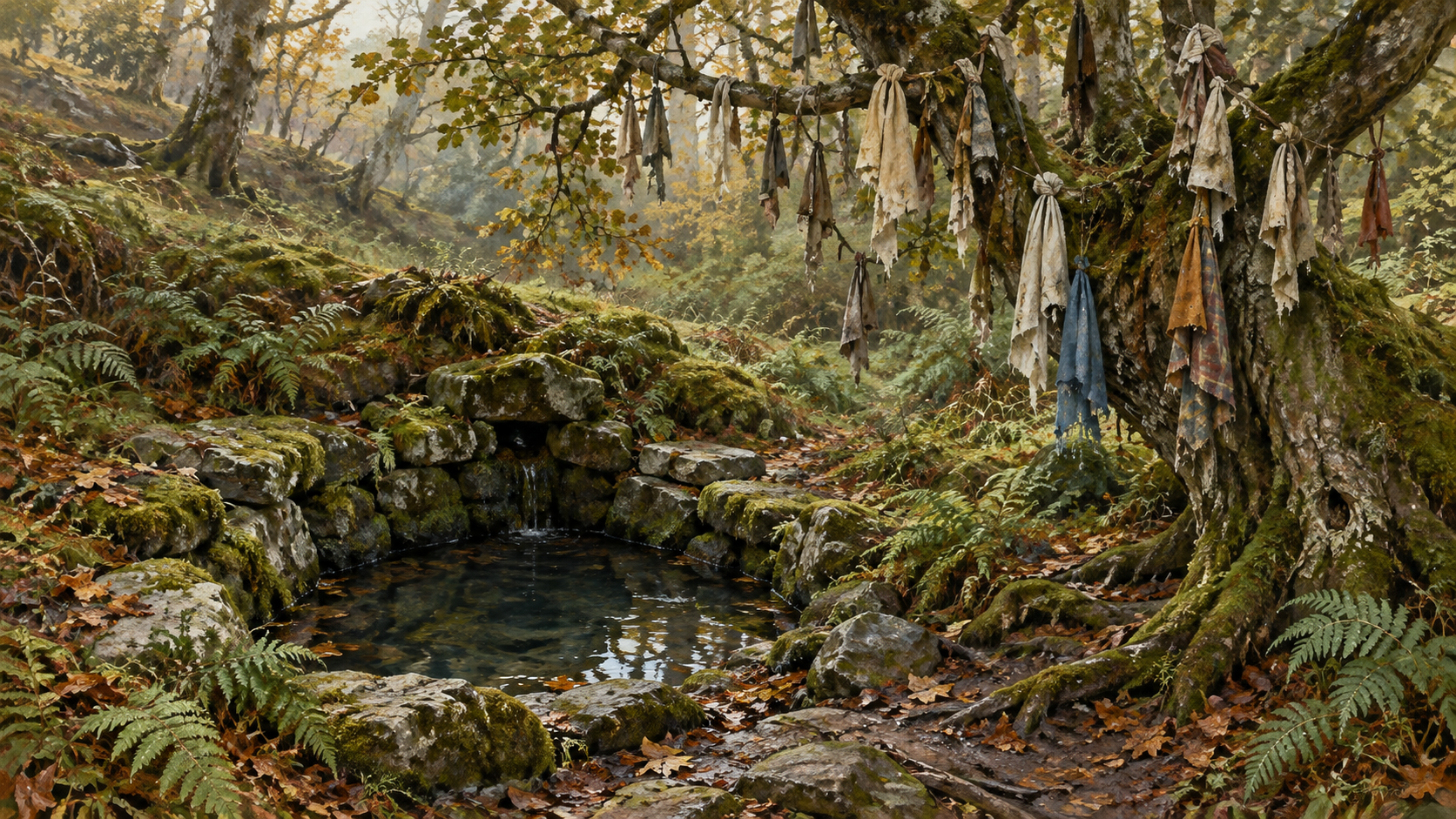
Cloth tributes beside a woodland clootie well. An imagined setting.
The gesture can be intimate. A scrap of cloth carries a concern too personal to put on public display, even as it becomes visible among the branches. In some traditions its decay is linked with recovery. Prayers to a saint, expectations of healing, wishes and contemporary Pagan interpretations may coexist, but we should ask what is actually said and done at the particular site rather than impose one explanation upon them all.
These are historical traditions of reputed healing, not established medical treatments. Their emotional and devotional significance is easier to document than their efficacy. Nor does a rag seen today tell us how old the custom is. A rag-well tradition near New Ross was recorded in a twentieth-century folklore collection: a useful witness to remembered practice, not a certificate of prehistoric continuity.
Offerings also have consequences. At Munlochy, visitors who leave a cloot are asked to use a small biodegradable piece of pure cotton or wool. Elsewhere, the appropriate conduct may be to leave nothing. The local custodians’ guidance matters more than a visitor’s wish to create a picturesque ritual.
How numerous are these sacred places
There is no defensible single total for sacred sites across the five regions. A holy-well record, a standing stone, an entire ceremonial landscape and an annual celebration are different units. Sacredness itself may refer to ancient ritual evidence, a later story, Christian devotion or present-day spiritual use. An inventory of monuments cannot tell us how many are actively revered.
Several figures give a sense of scale, though each measures something different.
In the Republic of Ireland, an April 2023 database export contained 3,025 records of holy wells, including wells whose locations were unknown. The figure excludes Northern Ireland and does not tell us how many wells remain places of active pilgrimage.
At Carnac, approximately 3,000 standing stones survive within the alignments. They are individual stones, not 3,000 separate sanctuaries, and the figure is not a total for Brittany. A wider count across 27 communes in southern Morbihan, between the Ria d’Étel and the Rhuys peninsula, gives 550 megalithic monuments, including 179 in Carnac commune. That count describes surviving monuments, rather than active sacred sites; it has no stated census date.
Across historical Brittany, including Loire-Atlantique, approximately 2,000 pardons are celebrated annually. This is an estimate of celebrations, not a count of unique sacred places or ancient Pagan rites.
These figures must not be added together or extrapolated into a comparable total for Scotland, Wales or Cornwall. Each of those regions has its own archaeological and heritage records, with classifications that would require a defined, dated study before numerical comparison.
The scale is nevertheless striking. Recorded wells number in the thousands in the Republic of Ireland alone, and thousands of stones survive in the Carnac alignments. Living rural observance is also documented, from well visits and cloth offerings to Breton patronal celebrations. This supports the richness of the sacred landscape; it does not show that every recorded place remains celebrated, or that everyone in a rural community shares the same belief.
Pagan and Wiccan encounters today
Contemporary Paganism is varied. Some people honour named deities, ancestors and seasonal changes; others speak more directly of relationships with a spring, woodland or hill. An animist may encounter a river as a presence with which to maintain relations rather than as scenery awaiting human use. Such approaches can deepen genius loci into a practice of attention and reciprocity.
Wicca took its recognisable modern form in the twentieth century, with Gerald Gardner prominent in its public development. Many Wiccans and Druids celebrate eight seasonal festivals, a shared cycle formulated in modern times. It should not be presented as a fully documented prehistoric calendar common to every Celtic region.
A Wiccan or Druidic visitor might greet the powers of a place, observe a season there, or meditate beside water. These are examples of possible present-day practice, not claims about what occurs at every named monument in this essay. Neither Wicca nor Druidry speaks for all local residents, and not every person leaving a token at a well identifies with either movement.
The most persuasive spiritual writing allows the actual place to lead. A winter burn does not need invented antiquity to be mysterious. A saint’s well does not lose its depth because its earliest surviving record is medieval. Meaning can be renewed, as well as inherited.
The obligation of the guest
When we enter a glen, a churchyard, a wood or a spring-fed hollow, we enter a history much older than our visit. The fern will uncurl whether or not we observe it. The burn will rise in spate after heavy rain. The land is not waiting to be made meaningful by our arrival.
Yet our arrival does matter. We can disturb the place or attend to it, turn its lore into a cheap curiosity or take the trouble to learn who told the story and why. We can imagine the supernatural with sensitivity, allowing its presences to be beautiful, troublesome, demanding and strange. We can also recognise the practical guardianship that falls upon us when habitats, languages and local memories are vulnerable.
Perhaps the best beginning is not a declaration that every hill has a spirit. It is the quieter possibility that every hill has a life and a history, and that some may also have a presence we do not yet know how to name.
We walk into the place as guests. The first courtesy is to listen.
My first action on visiting such places is to ask permission.
May I, Can I, Should I.