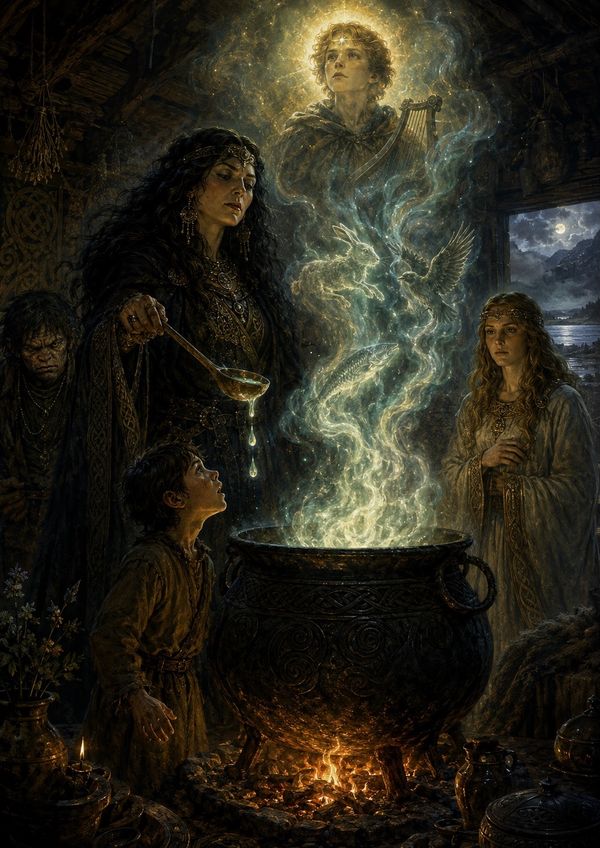
A Jungian Reading of Cerridwen and Taliesin
A reflective essay on archetypes, Awen, the dark feminine, initiation, and the birth of the bardic voice. * Read my earlier post with tale first please. https://daviddegernier.substack.com/p/cerridwen

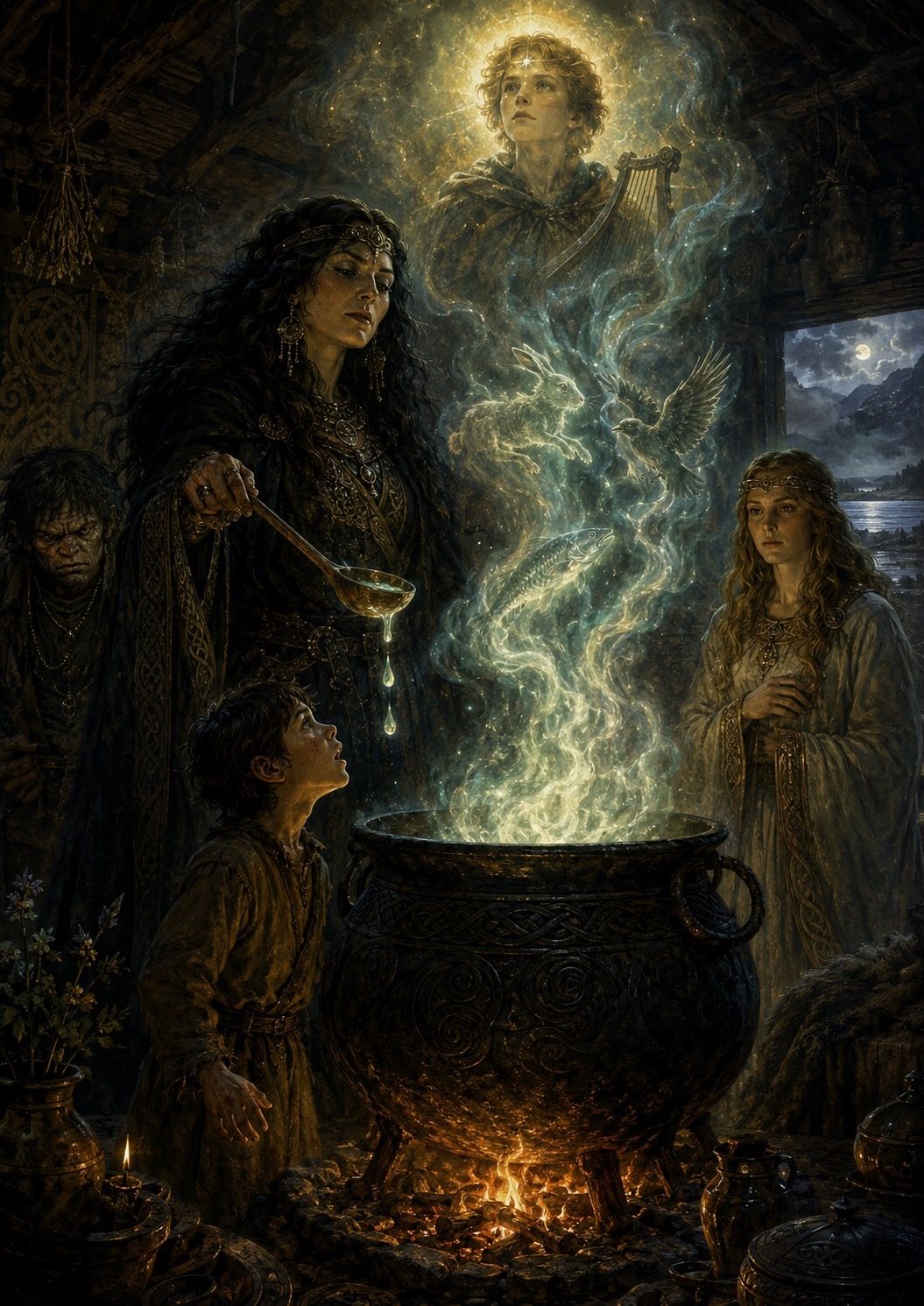
This essay has been written as an interpretive companion to the Walking with Nature tale, Cerridwen and Taliesin. It is not intended to reduce the story to psychology, or to flatten myth into a set of tidy meanings. Myth resists that. It breathes. It moves. It carries more than any single explanation can hold.
The purpose here is more modest, and also more useful: to open the tale as a symbolic pattern. Read in a Jungian spirit, the story becomes an account of inspiration, wound, pursuit, initiation, death, rebirth and the emergence of the bardic voice. It shows us that Awen is not merely a decorative word for talent. It is a force. Once received, it changes the one who receives it.
That is why this old Welsh legend remains so alive. It speaks to artists, poets, spiritual seekers, nature-lovers, wounded children, fierce mothers, and anyone who has ever felt summoned by something larger than the ordinary self.
Myth as a Map of the Inner Life
At first glance, Cerridwen and Taliesin is a tale of magic. There is a cauldron. A potion. A servant boy. A chase. A child set adrift upon the sea. All the elements of wonder are there.
But the tale is doing something deeper. It is tracing the movement of the psyche when ordinary identity is broken open by a power greater than itself. In Jungian terms, it can be read as a drama of individuation: the difficult movement towards wholeness in which the ego is challenged by forces from the unconscious. Those forces may appear as gods, mothers, monsters, animals, children, guides, shadows, voices, or sudden intuitions. In myth they take form, so that we may see them.
The story begins with Cerridwen, a figure of immense feminine authority. She is not a simple witch, and certainly not a mere villain. She is mother, goddess, sorceress, healer, destroyer and initiator. Her labour is driven by love, but wounded love; and wounded love, when it tries to command fate, can become dangerous.
She brews Awen for her son Morfran, hoping to compensate for his rejected outward appearance by giving him inward greatness. Yet the gift does not go where she intends. It falls to Gwion Bach, the overlooked boy, the servant, the one nearest the cauldron when destiny leaps. That accident matters. The deepest gifts of the psyche rarely arrive according to plan. They erupt. They burn. They choose their vessel.
Once Gwion receives the three drops, he is no longer innocent. His perception opens. Too much opens. He sees, hears and knows beyond the proper limits of his former life. Then comes the chase. Hare, fish, bird, grain. Earth, water, air, seed. He is stripped down to his smallest form, swallowed, carried in darkness, and born again as Taliesin.
This is not only a magical adventure. It is an image of the old self dying into the unconscious and returning as inspired consciousness. The bard is born from cauldron, pursuit, womb and sea.
Awen: The Numinous Creative Principle
The central mystery of the tale is Awen.
In ordinary language we might translate Awen as inspiration, poetic genius, or creative illumination. Those words help, but they are not enough. Awen is not simply the ability to write well, sing beautifully, or speak with charm. It is the movement of spirit through the human being. It gives speech a depth beyond intention.
From a Jungian perspective, Awen belongs to the realm of the numinous. The numinous is that charged, awe-filled encounter with something greater than the personal ego. It may exalt us. It may terrify us. Sometimes it heals; sometimes it wounds first. Either way, it is never merely decorative.
When Awen enters Gwion, his ordinary perception is shattered. He hears roots, stones, birds, trees and stars. He sees past and future. He perceives the hidden life of the world. This is not education. It is revelation.
The tale also makes clear that Awen cannot be owned. Cerridwen prepares it for Morfran, and her preparation matters. Without her cauldron, there would be no Awen in this form. Yet the final destination of the gift is not under her control. That is psychologically exact. The ego may prepare itself. It may study, practise, gather knowledge and tend the fire. But the living spark cannot be commanded.
Awen therefore stands close to what Jung called the Self: the organising centre of the whole psyche, larger than the conscious personality. The Self does not always serve the ego’s wishes. It may contradict them, wound them, redirect them, even break them. But its purpose is wholeness, not comfort.
In this tale, Awen breaks Cerridwen’s intention, terrifies Gwion, destroys the cauldron’s original purpose, and brings Taliesin into being. That is its terror. It is also its grace.
A Brief Map of the Archetypal Figures
Before moving through the figures one by one, it is useful to set out the symbolic field of the tale. Some of these figures are human characters. Others are objects, places, or presences that behave almost like characters within the inner drama. In myth, a cauldron or a sea may carry as much psychological weight as a speaking person.
Cerridwen carries the Great Mother, the Terrible Mother, the Wise Woman and the Initiatrix. Gwion Bach and Taliesin carry the overlooked child, the initiate, the Divine Child and the Bard. Awen itself is the numinous creative spirit. The cauldron is the alchemical womb. Morfran is the wounded shadow-child. Elffin is the receptive masculine, the one who recognises the gift. Creirwy is the bright counter-image. Morda tends the fire. Gwyddno Garanhir stands for the old paternal order. The narrator guides the audience as bard and psychopomp. The audience becomes the witnessing community. The animal forms carry the ordeal through instinct and element. The sea bears the reborn child from mystery into destiny. The leather bag conceals the gift. The salmon weir catches what the unconscious waters bring.
None of these meanings should be treated as a prison. An archetype is not a label pinned to a specimen. It is a field of living meaning. Cerridwen is not one thing. Nor is Gwion. Nor is Taliesin. Their power lies in the fact that they are layered, contradictory and alive.
1. Cerridwen: The Great Mother, the Terrible Mother, and the Initiatrix
Cerridwen is the governing presence of the tale. She begins the work. She prepares the cauldron, gathers the herbs, sustains the purpose and releases the chain of events that will end in Taliesin’s birth. Psychologically, she projects the Great Mother archetype in both its nourishing and destructive forms.
The Great Mother is never only gentle. She is the source of life, but also the power that may overwhelm life. She feeds, protects, conceives and gives birth. She may also smother, pursue, swallow and devour. Cerridwen contains both sides. That is what makes her compelling.
Her project begins in love. She sees the world’s cruelty towards Morfran and wants to arm him against it. No decent reading of the tale should miss that. Yet love becomes entangled with control. She does not merely wish him well; she tries to command destiny on his behalf. There the danger begins.
This is one of the story’s finest psychological subtleties. Cerridwen is not evil. She is wounded by the world’s mockery of her child. Her error lies in trying to compensate for that wound by forcing the numinous to serve a chosen outcome. In Jungian terms, she attempts to subject Awen to maternal will. The unconscious refuses.
As Wise Woman and Crone, Cerridwen knows the hidden virtues of plants, waters, roots and timings. She belongs to old knowledge: lunar, herbal, instinctual, magical and bodily. As Sorceress, she is the alchemical operator, the one who prepares the vessel. As Terrible Mother, she becomes the huntress. As Devouring Mother, she swallows Gwion. And as Initiatrix, against her own intention, she becomes the womb through which Taliesin is born.
That last turn is crucial. Her destructive aspect is also transformative. She hunts Gwion, but the hunt drives him through shape after shape. She swallows him, but the swallowing becomes gestation. She intends death, yet becomes mother of rebirth. This is the dark feminine as initiator: the force that frightens the ego beyond its old boundaries.
2. Gwion Bach and Taliesin: The Overlooked Child, the Initiate, and the Inspired Bard
Gwion Bach begins as the small one. The servant. The overlooked boy beside the cauldron. He is not a warrior, prince or chosen champion. He is near the centre of events precisely because he is doing humble work: stirring, watching, waiting.
In myth, such figures matter. The servant, the fool, the youngest child, the orphan, the ignored one: again and again, these marginal figures become carriers of transformation. Psychologically, Gwion represents the unnoticed possibility within the psyche. He is what consciousness has not yet valued.
He does not seize Awen through ambition. That matters. The drops burn him; he puts his thumb in his mouth by instinct. It is almost accidental. Yet myth knows the difference between accident and fate. The gift enters him because he is there, because he has served the vessel, because he is open enough - or unprotected enough - to receive what others intended to control.
Once Awen enters him, Gwion becomes the initiate. His eyes open inwardly. He hears and sees too much. The world is suddenly alive with meaning, and that meaning is not safe. His first great knowledge is not triumph. It is danger. Cerridwen will come.
The chase then becomes the ordeal of transformation. Gwion changes into hare, fish, bird and grain. He tries to escape, but each escape takes him deeper into the pattern. The forms are not random. They move through earth, water, air and seed-life. Fear, depth, spirit, sacrifice. Step by step, the boy is stripped of his first identity.
When he becomes grain and is swallowed, Gwion disappears. That could be the end. Instead, the tale makes darkness into womb. He is carried within Cerridwen for nine months and born again as Taliesin. He is Gwion, and not Gwion. Continuity remains, but the form is changed.
Taliesin is the Divine Child and the Bard. His shining brow marks him as more than an ordinary infant. He has passed through animal life, death, gestation and sea. When he later speaks, his voice carries memory from beyond the personal self. He sings not as a clever man, but as one who has been remade by the deep world.
3. Awen: The Spirit That Cannot Be Possessed
Awen is almost a character in its own right. It moves through the story like an invisible intelligence. Cerridwen seeks it. Morfran is meant to receive it. Gwion actually receives it. Taliesin embodies it. The narrator finally warns us that Awen may still be seeking someone brave, or foolish, enough to bear it.
This is why Awen should not be read as ordinary creativity. It is closer to the daimon, the sacred breath, the compelling inner necessity that overtakes a life. It is not under social authority. Kings cannot buy it. Scholars cannot command it. Even Cerridwen, for all her knowledge, cannot dictate its destination.
Awen is also dangerous. It changes the one who receives it. The old self cannot simply add Awen as a useful talent and carry on as before. Gwion receives the drops and immediately loses his former life. The gift opens him, exposes him, and sends him running.
That is often true of the creative vocation. Real inspiration is not always comforting. It may disturb the household, break old arrangements, reveal buried knowledge, or force a person into a life they did not consciously choose. Awen is blessing, but it is not tame.
4. The Cauldron: The Alchemical Vessel and the Womb of Transformation
The cauldron is one of the deepest symbols in the tale. It is black, vast-bellied, heated from below and filled with carefully gathered ingredients. Everything about it suggests the alchemical vessel: the container in which raw material is cooked until a new essence appears.
It is also a womb. Not a sentimental womb, but a dark, dangerous and creative one. Something is being formed inside it. The process cannot be rushed. It must last a year and a day, the old enchanted measure of time. Transformation, the tale tells us, has its own rhythm.
Only three drops contain the blessing. The rest becomes poison. That detail is psychologically exact. Contact with the numinous requires measure, timing and readiness. Too much, or the wrong relation to it, can poison rather than illumine.
When the cauldron cracks, the old container fails. Cerridwen’s intended ritual structure can no longer hold what has been released. Inwardly, this is what happens when an unconscious content erupts beyond the plans of the conscious mind. The vessel did its work. Then it broke.
5. Morfran / Afagddu: The Wounded Shadow-Child
Morfran, also called Afagddu, is not active for long in the outer plot, but he is one of the emotional causes of the tale. He is the child marked by rejection. Ill-favoured, mocked and whispered about, he carries the wound that begins the story’s movement.
Archetypally, he is the wounded shadow-child. He represents what society rejects: ugliness, vulnerability, shame, awkwardness, difference, and the pain of being seen without being loved. Cerridwen hears the mockery of her son as though it has entered her own body. Any parent would understand something of that.
Her desire to give him wisdom is therefore deeply moving. It is not simply vanity. It is an attempt to answer humiliation with inner power. Yet that very attempt creates imbalance. Morfran’s suffering becomes the emotional fire beneath a magical project that escapes its purpose.
In inner life, rejected parts of the self often generate compensatory fantasies. One day I will be so wise, so gifted, so admired, that no one can wound me again. Such fantasies may contain real creative energy. They may also be driven by shame. Morfran stands exactly at that threshold.
6. Elffin: The Receptive Masculine and the One Who Recognises the Gift
Elffin enters late, but his role is indispensable. He is thought unlucky. He goes to the salmon weir hoping for a good catch and finds, instead, a leather bag containing a radiant child. It looks, at first, like disappointment. It is not.
Elffin represents the receptive masculine. He does not brew the potion, steal the drops, win a battle, or master the sea. His greatness lies in recognition. He opens the bag, sees the shining brow, and names the child Taliesin.
Naming is a profound symbolic act. What comes from the unconscious must be recognised before it can enter life. Without Elffin, Taliesin might remain a miraculous foundling. Through Elffin’s recognition, he receives a place in the human world: name, relationship, destiny.
Elffin therefore represents the part of the psyche that can receive the unexpected gift without trying to dominate it. He is not the conquering hero. He is the one who opens the strange bundle and looks again. That is enough.
7. Creirwy: The Bright Counter-Image
Creirwy appears briefly, yet her symbolic function is clear. She is the beautiful daughter, the one upon whom light seems naturally to rest. She represents visible grace, social approval, brightness and ease.
Her importance lies in contrast. Beside Morfran, she sharpens the wound of difference. One child is welcomed by the eye; the other is rejected by it. The tale does not need to labour the point. We feel it.
Archetypally, Creirwy may be read as the bright anima-image or fair maiden: the idealised form that draws admiration without effort. Yet the story does not dwell on her because she is not where the transformation occurs. The deepest energy gathers around the wounded, the overlooked and the dangerous. Not around the already beautiful.
8. Morda: The Blind Fire-Keeper
Morda, the blind man who tends the fire, is a minor figure, but not an empty one. His blindness matters. He serves the process without fully seeing it. He keeps the heat alive, yet does not receive the central illumination.
Archetypally, he is the fire-keeper: the attendant of discipline, repetition and continuity. No transformation happens without such figures. Someone must tend the fire. Someone must keep the work going through the long year and a day.
Still, Morda also shows the limits of function. To keep the fire is not the same as receiving Awen. To serve a ritual is not necessarily to understand its outcome. He belongs to the necessary background labour of transformation.
9. Gwyddno Garanhir: The Background Father and the Old Order
Gwyddno Garanhir, father of Elffin, stands in the background. His salmon weir is the place where Taliesin is found. Symbolically, he represents the older paternal order: lineage, inheritance, property, social structure and worldly expectation.
The transformed child does not arise from that order. He enters it. The distinction matters. The established world does not create Awen, but it can provide the structure in which Awen is discovered, named and carried forward.
Gwyddno’s weir catches what the sea brings. In that sense, his world becomes the receiving edge between unconscious mystery and social life. The sacred arrives not in a palace, but in a practical place of fishing and provision. The ordinary threshold receives the extraordinary gift.
10. The Narrator: Bard, Psychopomp, and Keeper of the Fire
In this version of the tale, the narrator is not invisible. He is a living presence. He calls the listeners closer, places them inside the firelit circle, asks them to hear the rain and wind, and draws them again and again into the action.
This makes the narrator an archetypal figure in his own right. He is the Bard. He is also the Psychopomp, the guide who leads the audience from ordinary awareness into mythic participation. A psychopomp does not merely explain. He conducts. He takes the listeners towards danger, darkness and return.
The repeated invitations - listen, imagine, breathe, do not look away - create a ritual space. The audience is not being handed information. They are being initiated into the emotional pattern of the story. Good oral storytelling does this. It restores myth to the body, the breath, the nerves and the imagination.
11. The Gathered Audience: The Witnessing Community
The audience around the fire represents the collective psyche. They are the listening tribe, the human circle in which myth comes alive. Without listeners, the bardic act is incomplete.
The tale repeatedly draws them into participation. They are asked to come closer, to feel the turning of the story, to imagine Cerridwen, to hear the scratch of the hen, to breathe before the chase begins. They are not spectators only. They become witnesses.
This matters. Transformation may begin in solitude, but it does not remain private forever. Taliesin’s ordeal is personal; his song is communal. Awen passes through the individual and returns as story, music, memory and shared meaning.
12. The Animal Forms: Instinct, Element, and Initiation
The chase through animal forms is one of the most charged passages in the tale. Gwion becomes hare, fish, bird and grain. Cerridwen follows as greyhound, otter, hawk and black hen. Each pair belongs to a different field of existence.
The hare and greyhound belong to earth: fear, speed, instinct and pursuit. The fish and otter belong to water: the unconscious, emotional depth, fluidity and hidden danger. The bird and hawk belong to air: spirit, imagination, ascent and the terrible clarity of the high hunter. The grain and black hen belong to seed-life: sacrifice, food, death, fertility and rebirth.
This is not decorative metamorphosis. It is an initiatory descent through the layers of embodied life. Gwion tries to escape by changing form, but the pursuing archetype changes with him. Once a deep transformation has begun, there is no easy hiding place. Not in instinct. Not in emotion. Not in intellect. Not even in smallness.
The final transformation into grain is especially important. Grain must be buried, broken, eaten or transformed before it becomes new life. Gwion becomes seed. He is no longer merely fleeing; he is becoming capable of rebirth.
13. The Sea: The Great Unconscious
After Taliesin is born and Cerridwen cannot kill him, he is cast into the sea. This is not simply abandonment. Symbolically, the sea is the great unconscious: vast, impersonal, dangerous, maternal, ancient and transformative.
The sea differs from Cerridwen. Cerridwen is personal, fierce, wounded and intentional. The sea is larger and less personal. It carries without explaining. It cradles without belonging to anyone. It may drown. It may also deliver.
Taliesin’s sea journey is therefore a second gestation. He has already passed through Cerridwen’s body; now he passes through the wider body of the world. The sea carries him from magical origin into human destiny. What is born in darkness still has to reach the shore.
14. The Leather Bag: The Hidden Vessel
The leather bag is a humble symbol, but a powerful one. Cerridwen cannot keep the child and cannot kill him, so she wraps him and gives him to the water. The bag conceals the radiant child until the right person finds him.
Like the cauldron, the bag is a vessel. But where the cauldron is grand, hot and magical, the leather bag is small, dark and easily mistaken for something worthless. This feels psychologically true. The Self often arrives disguised. The miraculous may first appear as inconvenience, disappointment, burden, or poor catch.
Elffin expects salmon and finds a bag. Only when he opens it does the true gift appear. The new life of the psyche is often hidden inside forms the ego initially undervalues.
15. The Salmon Weir: The Threshold of Discovery
The salmon weir stands where human structure meets moving water. It is designed to catch fish, but instead it catches the child of Awen. That makes it a threshold symbol.
A weir is not the sea, and it is not the land. It is an edge, a receiving structure placed within the flow. Symbolically, it is the point at which unconscious material becomes available to conscious life. Something moves through the waters and is caught where human attention can find it.
The absent salmon matters too. In Celtic tradition, the salmon is often associated with wisdom. Elffin finds not the fish of wisdom, but the living child of wisdom. The failed catch becomes the greater catch.
The Movement of the Whole Tale
Seen as a single psychological pattern, the story moves with remarkable coherence. First there is a wound: Morfran’s rejection. Then comes compensation: Cerridwen’s attempt to brew Awen for him. Then the alchemical vessel is activated: cauldron, fire, herbs, waiting, the year and a day. Then the gift erupts and chooses the unexpected recipient. Gwion receives the three drops.
From there, the tale becomes ordeal. Expanded perception brings danger. Gwion flees. Cerridwen pursues. The boy passes through animal and elemental forms until he reaches seed-form. He is swallowed, disappears, and is carried in darkness. The darkness becomes womb. The swallowed grain becomes the radiant child. The child is cast into the sea, carried to the weir, recognised, named, and eventually becomes the bard whose song carries the memory of the deep world.
That is individuation in mythic form. The conscious personality does not grow merely by adding pleasant qualities to itself. It is seized, pursued, dissolved, re-contained and reborn. The result is not a return to innocence. Taliesin is not Gwion restored to his former life. He is Gwion transformed into a voice capable of bearing Awen.
The tale also warns against trying to possess inspiration. Cerridwen’s desire is understandable, even moving. But Awen refuses ownership. It passes where it must. The deepest creative force cannot be reduced to ambition, not even maternal ambition. It must be suffered, embodied and carried.
Why This Archetypal Reading Is Well Supported
This reading can be offered with confidence because the story’s symbolic pattern is unusually clear. It is not built upon one isolated symbol pulled out of context. The whole tale reinforces the same movement: wound, vessel, fire, gift, pursuit, metamorphosis, swallowing, gestation, sea-passage, recognition and inspired speech.
Cerridwen is surrounded by images of moon, root, thorn, herb, water, magic, power and goddess-like knowledge. These are classic attributes of the Great Mother and the Wise Woman. Her pursuit, devouring and gestation then reveal the Terrible Mother and the Initiatrix.
The cauldron is a black, heated, belly-like vessel in which raw materials are cooked for a year and a day. That strongly supports an alchemical and womb-like reading. The three drops of Awen act as the concentrated essence of the process. The remaining brew becomes poison, which tells us that transformation is potent but dangerous.
Gwion’s sequence of forms - hare, fish, bird and grain - carries him through instinct, water, air and seed-life. He is then swallowed, carried for nine months, born again, set adrift, found, named and revealed as Taliesin. Few mythic structures express death and rebirth more plainly.
The tale itself also defines Awen as dangerous inspiration. It is not ornament. It is not cleverness. It is the force that changes the one who receives it. That is very close to Jung’s sense of the numinous: a psychic reality greater than the ego, capable of disturbing ordinary consciousness and transforming it.
Finally, the narrator universalises the myth. The story does not leave Taliesin safely in the past. It tells us, in effect, that somewhere the cauldron is still simmering and the drops are still rising. Awen may still be seeking the person who is brave enough, or foolish enough, to receive it. That is why the tale remains alive. It is not only a Welsh legend. It is a living psychological pattern.
Closing Reflection
At its heart, Cerridwen and Taliesin is a story about the perilous birth of inspired consciousness. True creativity is not always gentle. It may begin in wound, labour, accident and fear. It may require flight through many forms. It may demand that the old self be swallowed by darkness before a truer voice can be born.
Cerridwen gives the tale its power because she embodies both love and danger. Gwion gives it movement because he carries the terrified human soul through transformation. Taliesin gives it fulfilment because he returns from darkness with song. Awen gives it mystery because it remains beyond ownership.
For Walking with Nature, this legend has a particular resonance. The living world is not treated as silent background. Root, river, bird, stone, sea and wind are participants in the awakening of the soul. To seek Awen is to risk being changed by what we hear when the world speaks back.
That is why the story endures. Somewhere, the cauldron is still simmering. Somewhere, the drops are rising. Somewhere, the song beneath all songs is waiting for the one who can bear it.