Cerridwen and Taliesin
The Cauldron of Inspiration

The Cauldron of Awen
Come in closer.
No, closer than that.
Let the firelight illuminate and warm your faces, and let the dark stay where it belongs — beyond the door, beyond the threshold, beyond the little circle of warmth we have here made together. Listen now to the rain on the roof. Listen to the wind worrying at the roof slates. Listen to the tempestuous night pressing itself against the walls and knocking on the door, seeking entry.
Good.
For this is a tale that belongs to such a night.
It is not a tale for bright noon, nor for idle chatter, nor for men and women with one ear turned elsewhere. This is a tale of deep water, of smoke, of pursuit, of terror, of birth, and of Awen — that holy breath of inspiration, that sudden flame in the mind, that gift no scholar can command and no king can buy.
Awen.
Remember that word.
It is the shining thing sought by poets, prophets, druids, singers, and all who have ever stood alone in wild country and felt the world speak back.
Now listen.
Long ago, when Wales was still young in the memory of people, when mist lay thick in the mountain passes and the lakes held secrets beneath their black surfaces, there lived beside the waters of Llyn Tegid a woman named Ceridwen.
Ah, Ceridwen.
Do not picture some bent old crone or hag muttering over a pot. No. Put that foolish picture away.
Yes, she was a hag, but in the true sense.
Ceridwen was a woman in the powerful stage of her life.
Ceridwen was strength, knowledge.
Ceridwen was the dark edge of the new moon and the green force rising through root and thorn. She knew the virtue of herbs before they flowered. She knew which plants must be gathered in silence, which roots must not be cut with iron, but with bronze, or flint. She knew to only gather at the correct phase of the moon and season, which berries would heal, also, which baneful ones would kill, which leaves would blind, and which waters remembered the speech of the old world.
Some called her enchantress.
Some called her witch.
Some, more wisely, lowered their voices and called her goddess.
And she had two children.
Her daughter was Creirwy, fair as a dew-covered spring morning. The world smiled upon that girl. Light rested on her as birds rest on a wispy reed. Wherever she went, beauty went beside her.
But her son — ah, her son.
His name was Morfran, named as though some knew him as Afagddu, utter darkness, Sea Crow. He was ill-favoured, misshapen, hard to look upon by the cruel standards of men. And you know men. You know women too. You know the sharpness of tongues when kindness fails. They mocked him. They whispered. They looked, and looked away, and laughed when they thought Ceridwen did not hear.
But she heard.
A mother always hears.
She heard every insult as if it had been spoken into her own flesh. Every cruel glance fell into her heart like a stone into a well. And the darkness in that well grew deeper.
One night, when the lake lay still and black beneath the stars, Ceridwen stood alone and made a vow.
“If the world will not love my son for his face,” she said, “then it shall bow to him for his wisdom. If men will not praise his form, then they shall tremble before his mind. I will give him Awen. I will give him inspiration. I will give him knowledge so deep that no bard, no druid, no prince, no king shall stand above him.”
There now.
Do you feel it?
That is where the tale begins to turn.
Not in wickedness. Not at first. In love. In wounded love. In a mother’s desperate wish to arm her child against a cruel world.
But love, when it tries to command destiny, may set terrible things in motion.
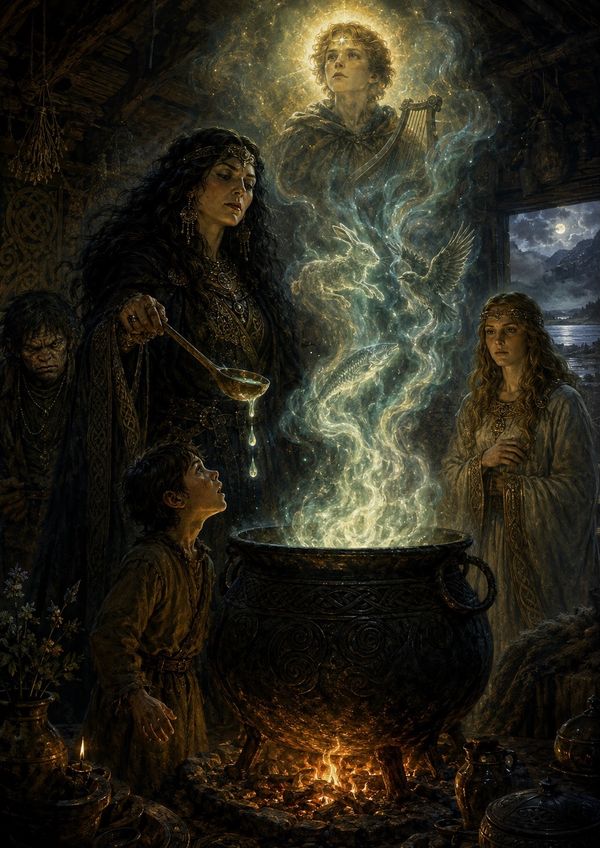
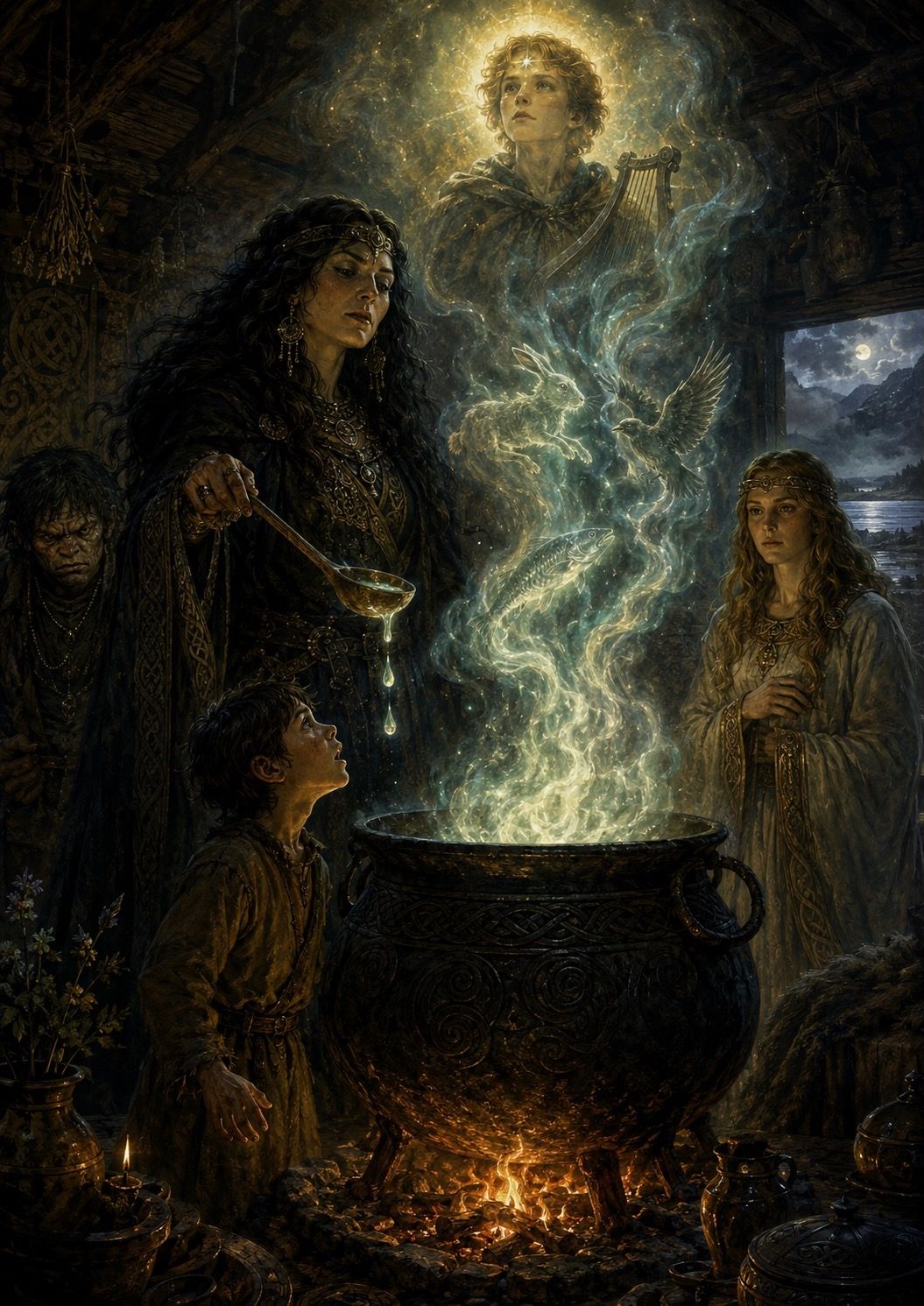
Ceridwen brought out her great cauldron.
Black it was, vast-bellied, heavy as a sleeping beast, and into it she poured water drawn with ritual care. Then began the gathering.
From marsh and hedgerow, from wood and mountain, from moonlit ditch and frost-hardened field, she gathered the herbs the potion required. Roots twisted like old fingers. Bark from trees that had watched generations pass. Berries dark as blood. Seeds small as secrets. Flowers that opened only in the hour when ordinary folk were asleep.
Into the cauldron they went.
And beneath it the fire was kindled.
But this was no common brew. Oh no. Do not think a charm can be made with a careless hand and an impatient heart. This potion had to boil for a year and a day.
A year and a day.
That is the measure of enchantment. That is the time beyond ordinary time. Long enough for a child to grow restless, for a watcher to grow weary, for seasons to rise and fall and rise again. Long enough for the world to test whether desire is truly desire.
And at the end, only the first three drops — three drops, no more — would contain the blessing.
Three drops of Awen.
Three drops of perfect inspiration.
Three drops that would open the mind like a door in the side of the world.
All the rest of the cauldron, once those drops had flown, would turn to poison.
So Ceridwen set watchers over the brew. A blind man named Morda tended the fire. And beside the cauldron stood a boy named Gwion Bach.
Little Gwion.
No prince. No hero. No warrior with a bright sword. Merely a boy. A servant. Small, quick, watchful. The sort of child who sees everything because no one thinks to look at him.
His task was simple.
Stir the cauldron.
Do not stop.
Do not sleep too deeply.
Do not let the brew settle.
Do not let the fire fail.
So Gwion stirred.
The days passed.
The nights passed.
Winter came with its iron breath. Spring loosened the ground. Summer thickened the hedges. Autumn burned the leaves gold and red. Still the cauldron seethed. Still Gwion stirred. Still the vapour rose.
And what vapour it was.
Can you not see it? Can you not smell it? Can you not taste it? There, above the pot, twisting in the firelight. Seeking the rafter to escape. Now it seems a serpent. Now a bird. Now a face. Now a hand reaching out and vanishing. The air around that cauldron was thick with more than steam. It was thick with becoming.
Gwion watched it.
He could not help but watch.
Night after night, the brew muttered and sighed. Sometimes it sounded like a distant thunder. Sometimes like rain in leaves. Sometimes like a voice just beyond understanding.
And perhaps, though he did not yet know it, Awen was already circling him.
Not entering.
Not yet.
But circling.
At last, the year and the day drew to their end.
The fire burned low and fierce.
The cauldron trembled.
Morda bent close to the flames.
Gwion tightened his hand upon the stirring rod.
The whole house seemed to listen.
Then—
Hiss!
The potion spat.
Three bright drops sprang from the black surface like sparks from the heart of a star. They flew through the steam, burning with the labour of a year and a day, and fell upon Gwion Bach’s thumb.
He cried out.
Of course he cried out. He was only a boy, and the pain was sudden. Without thought, without plan, without wickedness, he thrust his scalded thumb into his mouth.
And there, my friends—
There.
The tale catches fire.
For the three drops were swallowed.
The Awen entered him.
Not Morfran, for whom the cauldron had been made.
Not Ceridwen, who had bent her will toward it.
Gwion Bach.
The servant boy.
The overlooked child.
The one standing closest when destiny leapt.
His eyes opened.
No — more than opened. They were torn open inwardly.
He heard the lake breathing in the dark. He heard the roots drinking beneath the soil. He heard stones remembering the mountains they had fallen from. He heard the speech of birds, the grief of trees, the names of stars, the secret music turning in the bones of the earth.
He saw the past.
He saw the future.
He saw the shape of things hidden behind things.
And with all that splendour came one cold, terrible knowledge.
Ceridwen would know.
Ceridwen would come.
Ceridwen would kill him.
And at that very moment the cauldron cracked.
The potion, its blessing spent, became poison. It split the vessel and spilled out across the floor. The labour of a year and a day was ruined. The gift meant for Morfran was gone.
Then Ceridwen entered.
Imagine her.
Do not look away.
Imagine the doorway darkening. Imagine her seeing the broken cauldron. Imagine her seeing the fear on the boy’s face. Imagine the truth moving through her like lightning.
Her son’s gift was stolen.
Her work was destroyed.
Her hope lay smoking on the floor.
And the boy — the boy — held the Awen inside him.
Ceridwen screamed.
The house shook with it.
Gwion ran.
Now breathe, all of you. Breathe once, for from here there is no rest.
Out into the world he fled, and behind him came Ceridwen.
Not walking.
Not following.
Hunting.
Across the yard he ran, across the wet ground, under the low sky, with the new wisdom blazing in him and terror beating in his chest.
He knew now the secret of changing shape, and desperation taught him speed. He bent himself toward the earth, gathered his fear into his bones, and became a hare.
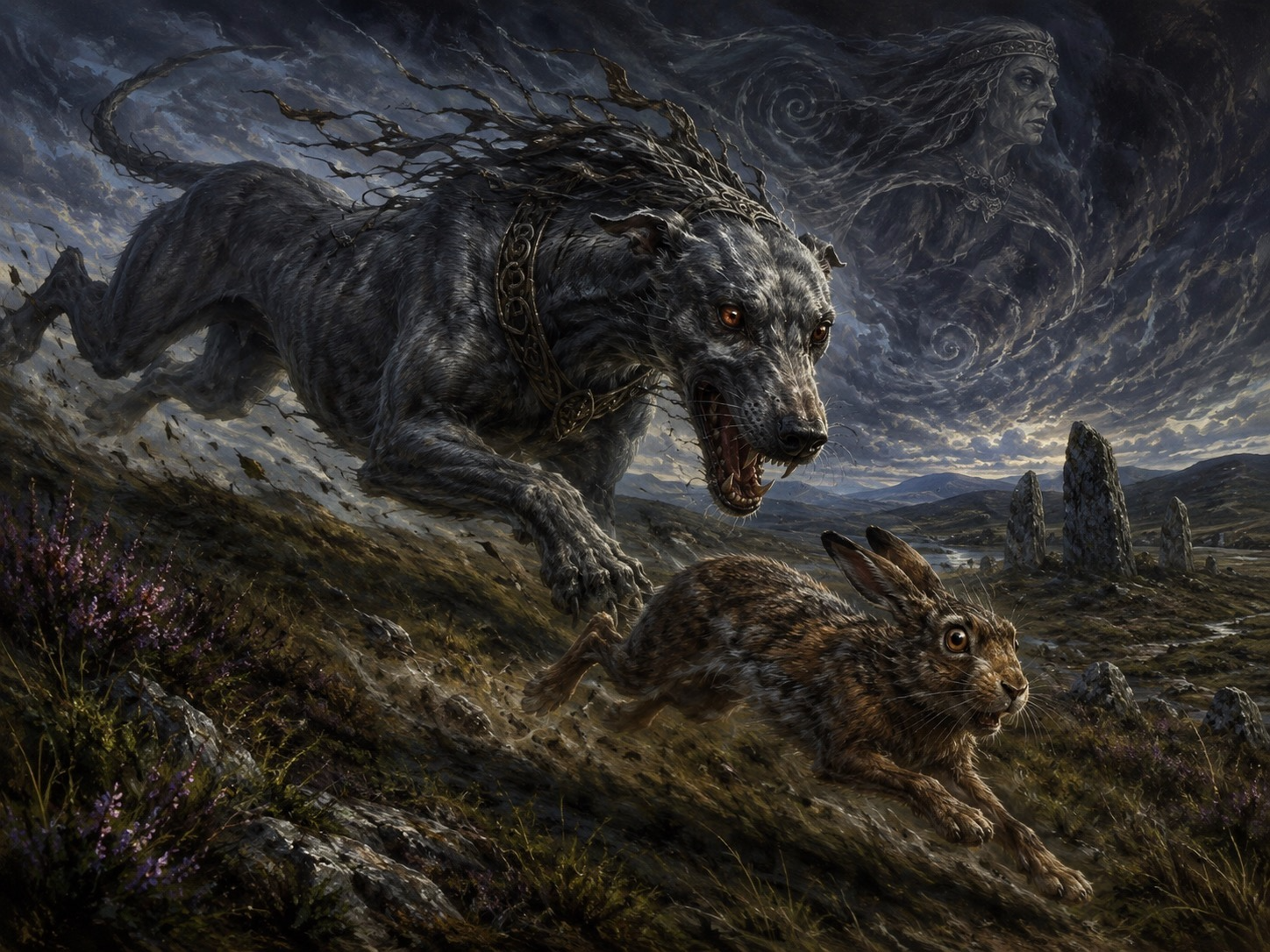
Away he sprang.
Over field and furrow, through rush and thorn, he ran with the wild heart of the hare. His ears lay flat. His paws struck mud. The world became scent, sound, and flight.
But Ceridwen saw.
Ceridwen changed.
She became a greyhound.
Long-limbed, narrow-flanked, terrible with hunger, she coursed after him. Her feet struck the ground like drumming. The hare twisted. The greyhound turned. The hare doubled back. The greyhound cut across. The distance closed.
“Run, Gwion,” you want to cry.
Run, little hare.
Run, little thief of Awen.
Run, before the teeth take you.
He reached the river and leapt.
As he struck the water, he became a salmon.
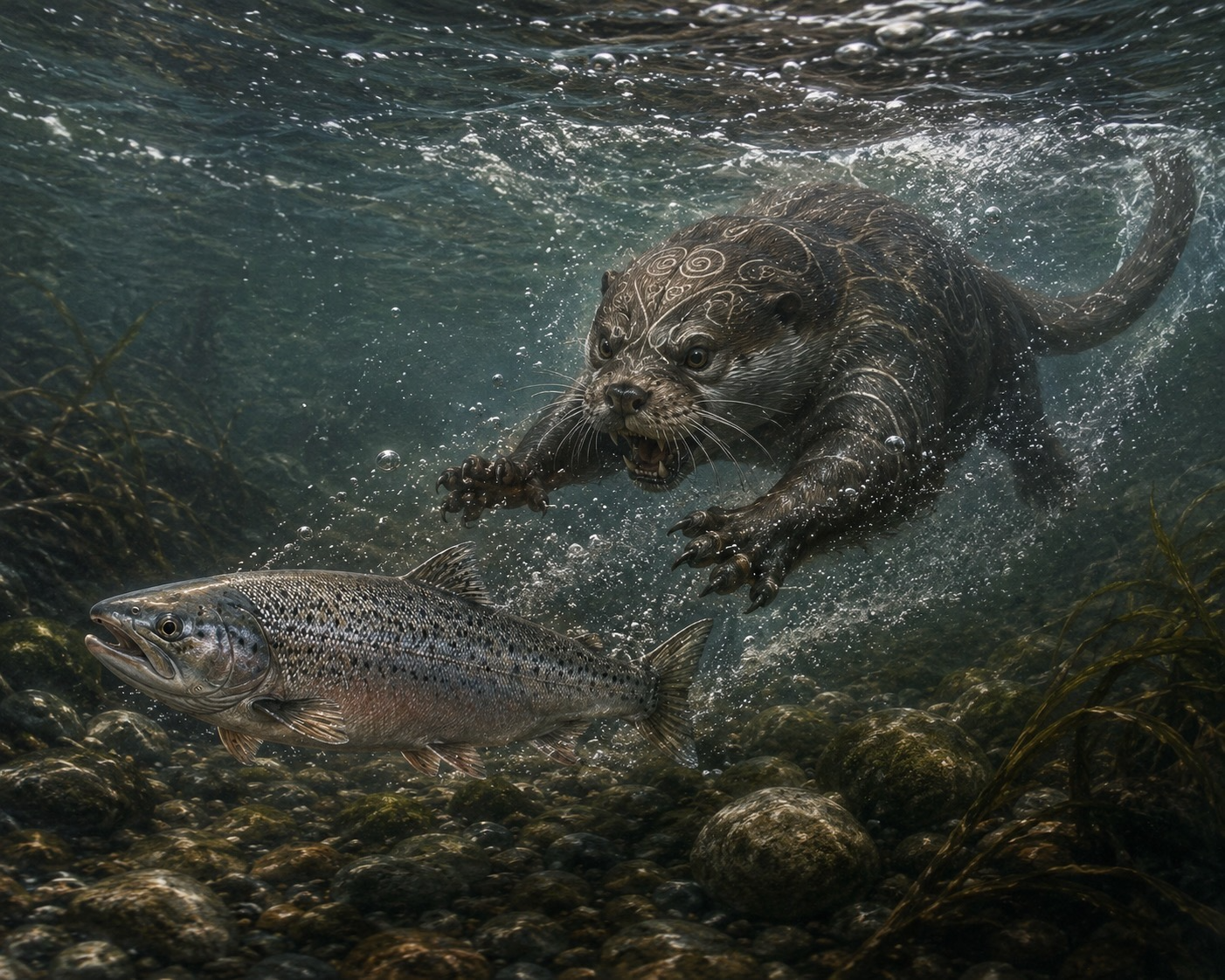
Down he flashed into the cold current, silver and quick, slipping between weed and stone. The river wrapped him. The light broke above him. For one heartbeat he thought, “I am hidden.”
But Ceridwen came to the bank.
And Ceridwen changed.
She became an otter.
Ah, there is no mercy in an otter’s pursuit. Sleek, dark, sinuous, she entered the water like a blade. Through the current she came, under roots, around stones, through green shadow, her body made for the river, her hunger made for him.
Gwion darted downstream.
Ceridwen followed.
He fled beneath a fallen branch.
She slid after him.
He twisted through weed.
She tore through it.
The river that had promised escape became a throat closing around him.
So he rose.
He burst from the water and became a bird.
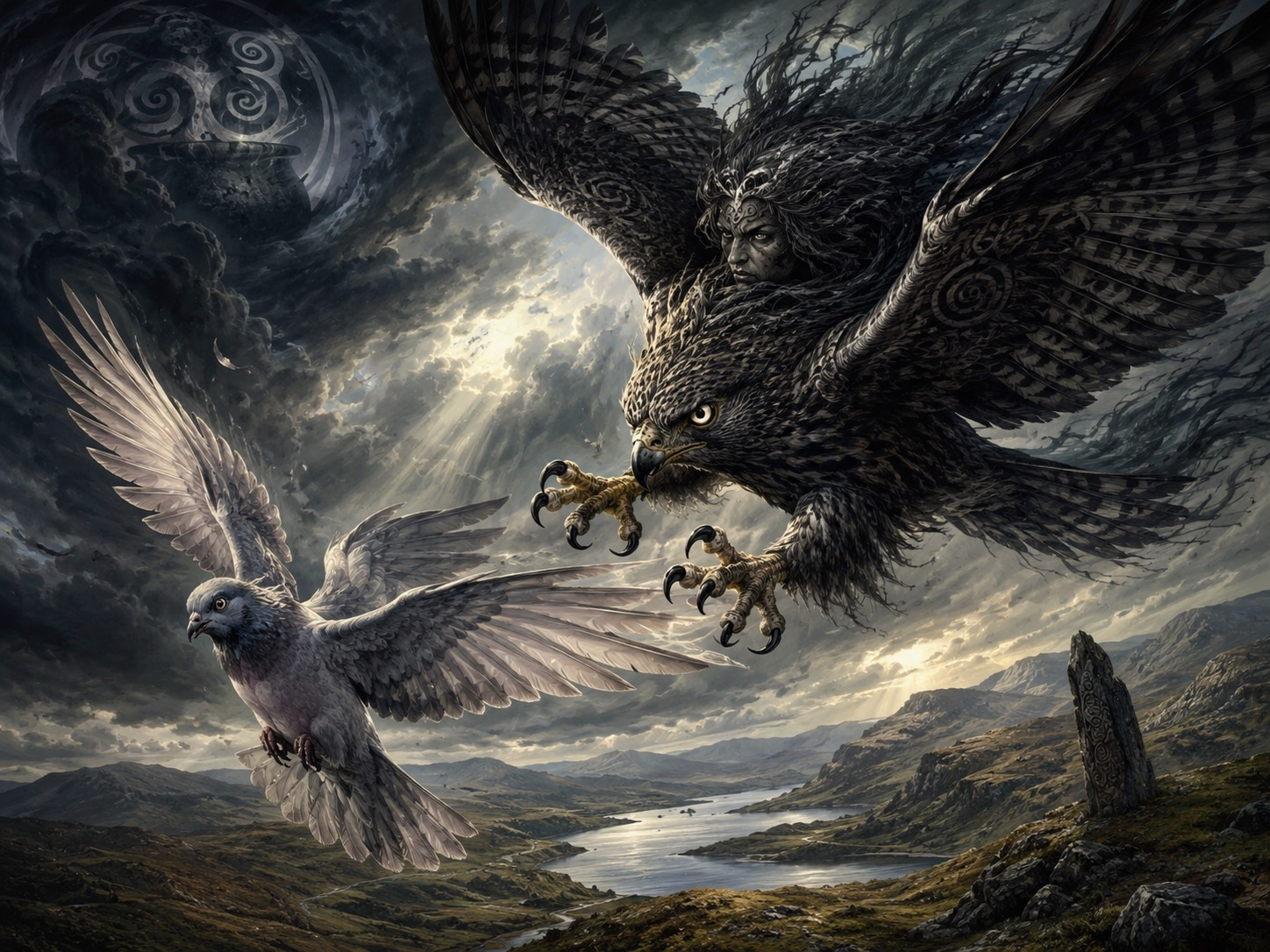
Up! Up into the air!
Wings beat where fins had been. The river fell away beneath him. Fields opened. Trees shrank. Wind took him. For a moment, the sky itself seemed to save him.
But look there.
Above the trees.
A shadow.
Ceridwen had changed again.
She was a hawk.
A hawk with a hooked beak and burning eyes. A hawk with wings made for height and death. She climbed after him, silent now, and silence was worse than screaming.
Gwion flew until his breath was fire.
He turned.
She turned.
He dropped.
She dropped.
He climbed.
She climbed higher.
The sky was no refuge. The open air was only another hunting ground.
Then, below, he saw a threshing floor.
And upon it lay a heap of wheat.
With the last of his strength, Gwion plunged downward. As he fell, he changed himself into a single grain of wheat and hid among the many.
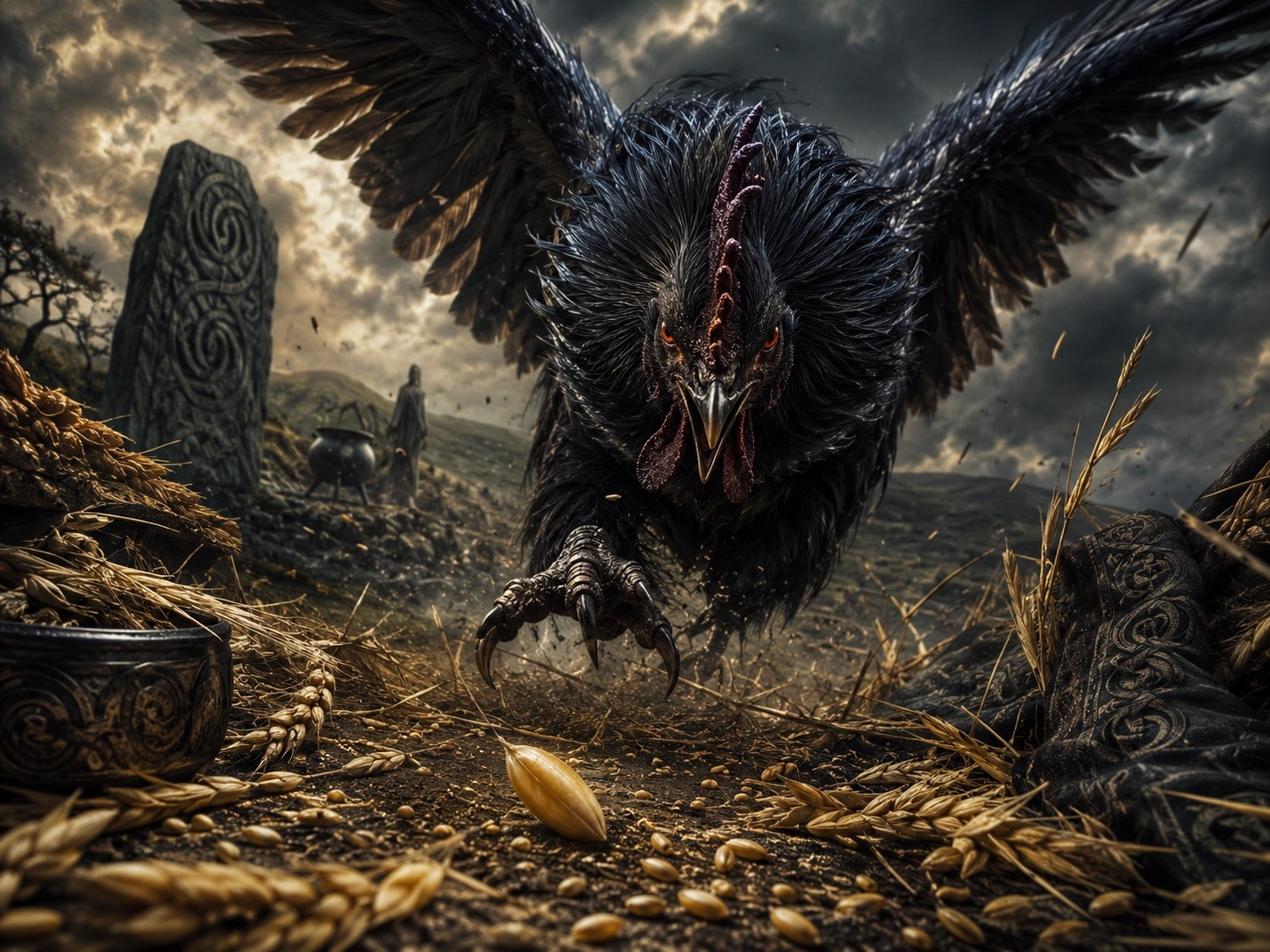
One grain among thousands.
Small.
Still.
Silent.
Now, perhaps, you think he is safe.
No wing can find him there.
No tooth can seize him.
No claw can know which grain is Gwion.
But Ceridwen was not only anger.
Ceridwen was wisdom.
She descended to the threshing floor and became a black hen.
Scratch.
Scratch.
Scratch.
Can you hear it?
Her claws moved through the wheat.
Scratch.
Scratch.
Her beak struck down.
Tap.
Tap.
Tap.
Grain by grain, she searched. Not hurried now. No need for speed. The chase had narrowed from field to river, from river to sky, from sky to a heap of wheat. All the vast world had become this one small place.
And then she found him.
The grain that was Gwion Bach.
She lowered her beak.
She swallowed him.
Silence.
There is a moment in every true tale when the fire seems to sink. The audience stops breathing.
This is that moment.
Gwion is gone.
The boy is swallowed.
The seeker of Awen, the thief of inspiration, the child of accident and destiny, has vanished into darkness.
But listen carefully.
The old stories know things we forget.
They know that darkness is not always an ending.
They know that what swallows us may also transform us.
They know that a grave and a womb are both places of darkness, but only one is final.
Ceridwen carried Gwion within her for nine months.
Think of that.
The one she hated, she carried.
The one she pursued, she nourished.
The one she meant to destroy, she bore beneath her heart.
What did she feel in those months? Rage, yes. Grief, certainly. Bitterness, no doubt. But perhaps also dread. Perhaps wonder. Perhaps the terrible knowledge that Awen cannot be dragged back once it has entered the world. Perhaps she understood that what had happened could not be undone.
At last, her time came.
Ceridwen gave birth.
And the child born from her was beautiful.
More than beautiful. There was brightness about him. His brow seemed touched by unseen fire. His face held the memory of deep things. He was Gwion, and not Gwion. He was the boy who had stirred the cauldron, and the hare, and the fish, and the bird, and the grain, and the child of darkness. He had passed through pursuit, through death, through the body of the one who hunted him.
He had been remade.
Ceridwen looked down at him.
She had meant to kill him.
She had sworn it in her heart.
But when she saw him, she could not do it.
Even Ceridwen, fierce Ceridwen, wise Ceridwen, terrible Ceridwen, could not lift her hand against that shining child.
So she did what people do in old tales when they cannot keep and cannot kill.
She wrapped him in a leather bag.
She carried him to the water.
And she cast him into the sea.
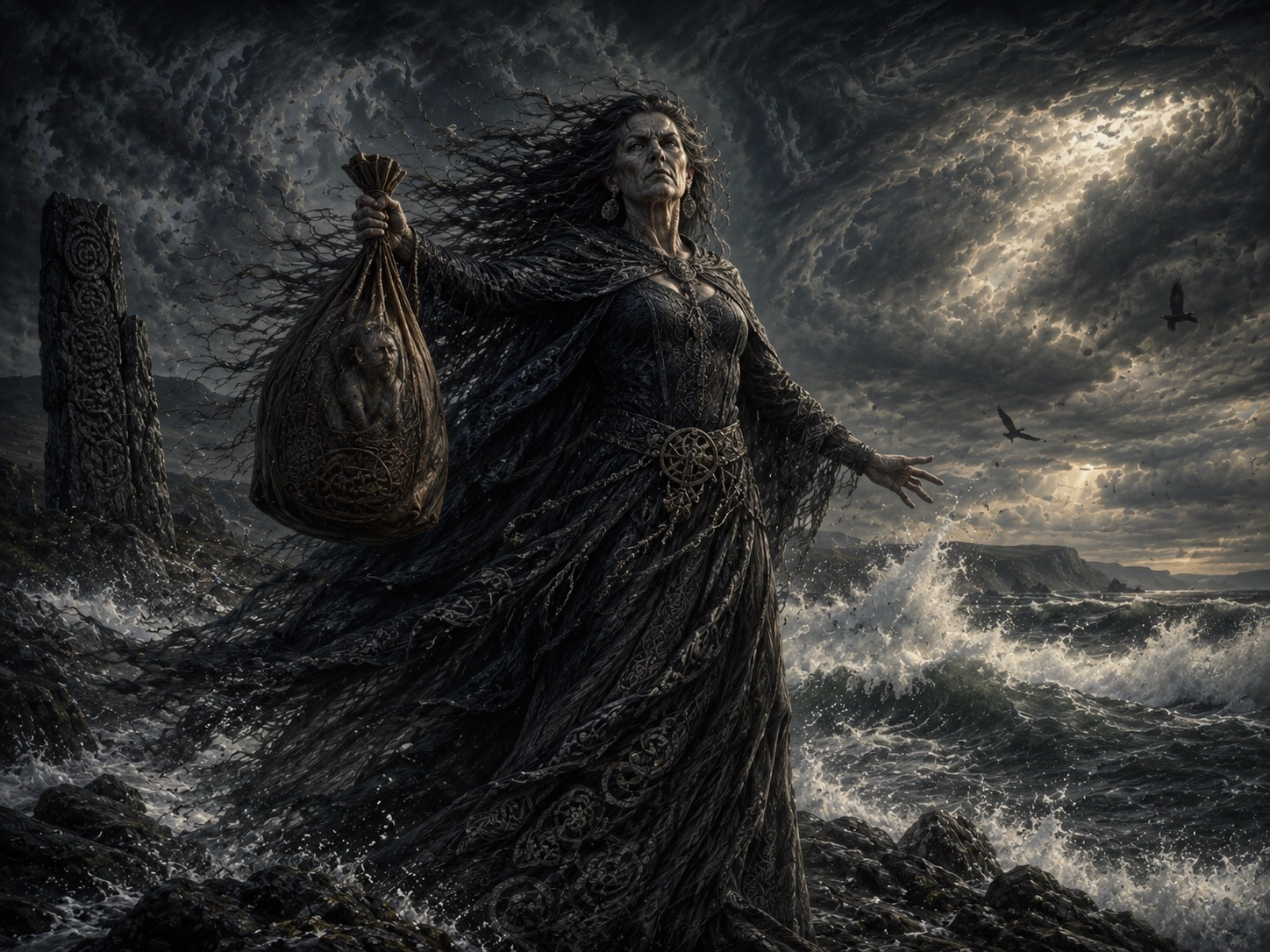
Ah, the sea.
Not a road, and yet it carries.
Not a mother, and yet it cradles.
Not a grave, though many sleep in it.
The child drifted.
Day after day, night after night, he moved upon the waters. Rain fell on the leather. Gulls cried overhead. Waves lifted him and lowered him. Beneath him, the deep rolled and murmured. Around him, the world was nothing but water, sky, and the long patience of fate.
Now far away there was a prince named Elffin, son of Gwyddno Garanhir.
And Elffin was unlucky — or so men said. Poor Elffin. Some men are named unlucky so often that even fortune hesitates to visit them. He went one day to his father’s salmon weir, hoping at last for a good catch. Perhaps there would be fish enough to silence mockers. Perhaps this day would prove him worthy.
But when he came to the weir, there were no salmon.
No silver bodies.
No thrashing tails.
No rich harvest from the water.
Only a leather bag.
Imagine his disappointment.
Imagine those with him laughing already.
But Elffin opened the bag.
And inside he saw the child.
The child looked up at him with a brow bright as if dawn itself had been folded beneath the skin.
Elffin stared.
Then he said, “Taliesin.”
Radiant brow.
Shining brow.
And so the child was named.
Taliesin.
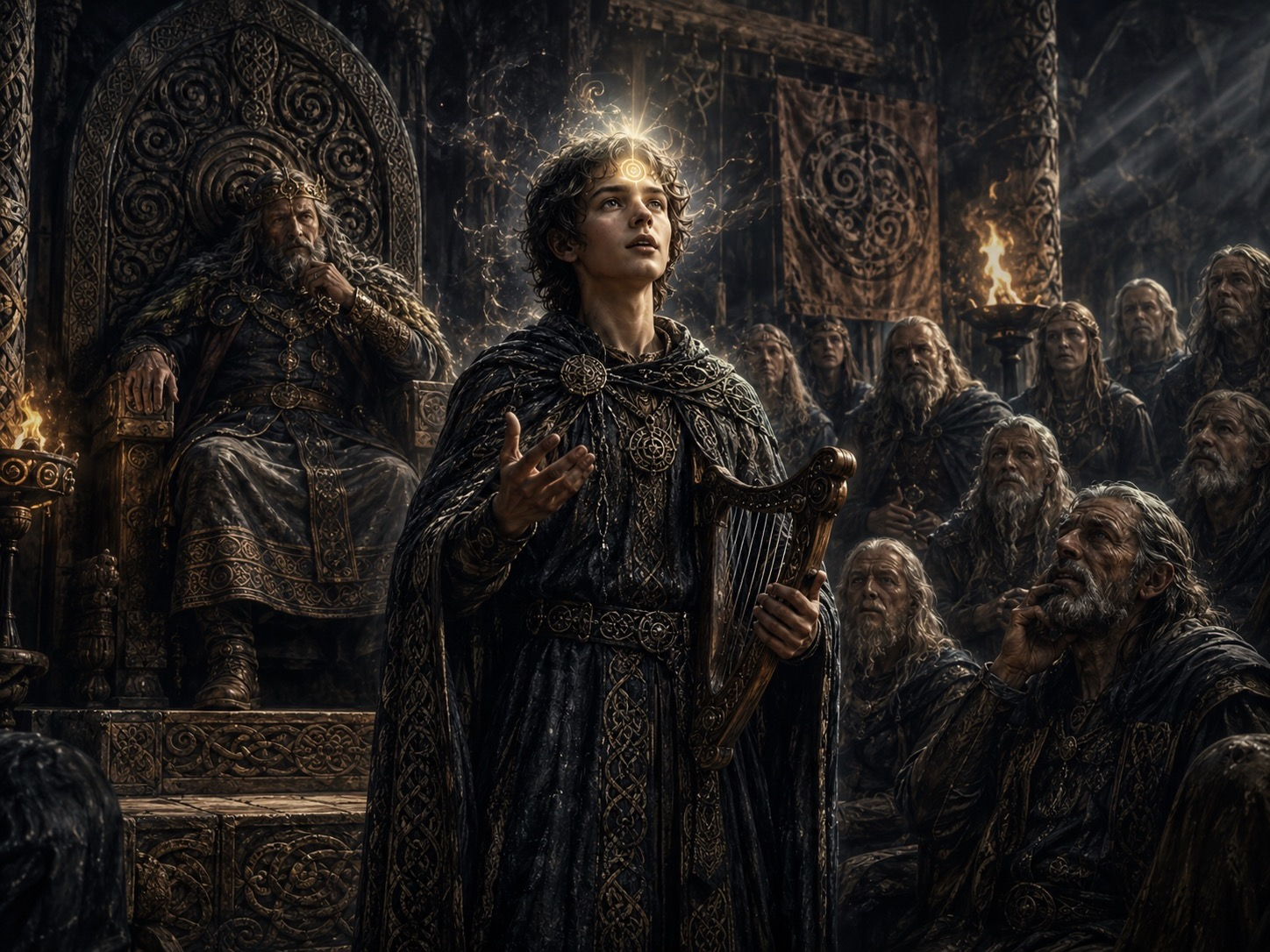
Remember that name well, for it is a name that rings through the halls of Welsh legend like a harp string struck in a silent room.
Elffin took the child home, and from that moment his fortune changed. For Taliesin was no ordinary foundling. He was filled with Awen. The cauldron’s three drops burned within him. The sea had carried him, but it had not drowned him. Ceridwen had swallowed him, but had not ended him. He had come through every shape and every darkness bearing the gift that cannot be forced, only received.
And when Taliesin spoke, people listened.
Not because he was loud.
Not because he was royal.
Not because he carried a sword.
They listened because his words had the ring of the deep world in them.
He sang as one who remembered being many things. He sang as one who had run with the feet of a hare, swum with the body of a fish, flown with the wings of a bird, hidden as a grain of wheat, and slept in the dark before birth. He sang as one who knew that life is not one shape only. He sang as one who had been hunted by death and returned with music.
That is Awen.
Not prettiness.
Not cleverness.
Not ornament.
Awen is the breath that moves through the true poet. It is the force that seizes the tongue and makes it speak what the mind alone could never invent. It is dangerous because it changes the one who receives it. It cannot be held in a locked chest. It cannot be poured obediently into the mouth chosen for it. Ceridwen brewed it for Morfran, but destiny gave it to Gwion. Gwion fled with it, died into it, and was born again as Taliesin.
So now, as the fire lowers and the shadows grow tall, remember what this tale has shown us.
The seeking of Awen is not a gentle pastime.
It is a cauldron watched through winter.
It is a thumb burned by sudden fire.
It is the terror of being seen.
It is the chase across earth, water, and sky.
It is the swallowing darkness.
It is the sea journey with no oar in the hand.
And, for the one who survives, it is the shining brow.
Taliesin did not become great because he remained safe. He became great because he was broken open, remade, and carried through the hidden ways of the world.
That is why his song endured.
That is why kings bowed their heads.
That is why, even now, when the night is deep and the wind moves over the hills, we still speak of Ceridwen’s cauldron, Gwion Bach’s flight, and Taliesin, the radiant-browed bard.
For somewhere, even now, the cauldron is simmering.
Somewhere, the three drops are rising.
Somewhere, Awen is seeking the one who is brave enough — or foolish enough — to receive it.
And should those drops fall upon you, my friends, be warned.
You may gain wisdom.
You may gain vision.
You may gain the song beneath all songs.
But first—
you may have to run.