Sluagh na marbh
The Host of the Unforgiven Dead.
An original Samhain fireside tale drawn from Scottish and Irish folk belief.
The old man waited until the last of us had come inside before he spoke. Rain shone on the shoulders of our coats, and the youngest child was still stamping water from her boots upon the flags. Behind us the door closed heavily into its frame. He watched the woman of the house lower the latch, then turned his eyes towards the shutter on the western wall.
Outside, the village lay beneath a sky that had been threatening all afternoon. The mountains were lost above their lower slopes, and the moon appeared only when the clouds tore apart sufficiently to show it. A little light remained in the kirk window at the end of the lane. Elsewhere, the cottages had drawn their shutters and settled into the darkness, with smoke pressed low over their roofs by the wind.
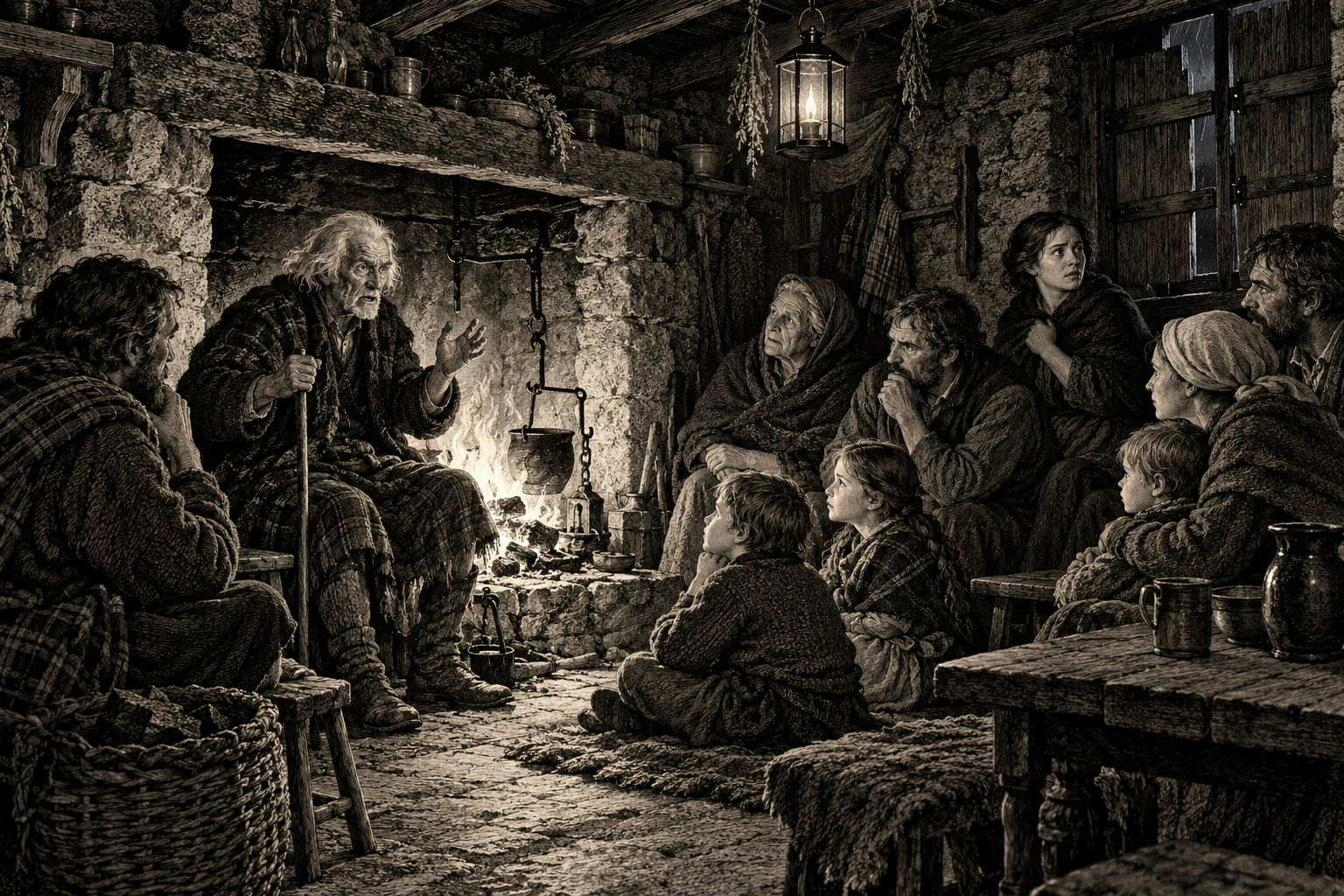
The peat fire had burned down to a steady red heart. Its smell lay in the wool of the blankets and in the rough timber of the stools drawn about the hearth. A lantern hung from a beam above the table, lighting the hands of those nearest it while leaving the rafters almost black. Beside the old man's chair stood a basket of peat and a walking stick polished by years of use.
He had a narrow face, with the skin drawn closely over the bones, and hair so thin that the fire showed through it where it hung beside his ears. He kept his right hand beneath a fold of his coat. When the child nearest him asked whether we were to have a tale, he looked at her gravely, as though considering how much she ought to hear.
“You shall have one,” he said. “But leave that shutter as it is. There are enough of us gathered here already.”
The woman of the house looked again at the window before taking her seat. Something knocked upon the chimney, and a scatter of soot came down into the fire. The old man listened until the sound had passed. Then he leaned a little forward, and began.
“You know what night this is. You have had your games, and the children have been about the doors, and there is still cake upon the table. By morning we shall be speaking of winter as something that has arrived. Tonight, however, there are older matters to consider, and there were people before us who would have considered them very carefully indeed.
“Samhain was a turning in the year that a household could feel in its bones. The harvest had been gathered as well as the weather allowed, and the animals that would carry a family through winter had to be kept alive. The light was failing earlier with every passing day. A long night upon an empty road could bring a man to remember warnings he had laughed at over his breakfast.
“In Ireland they speak of Oíche Shamhna, and here in the Gaelic country you will hear Samhainn. There were differences between one place and the next, as there always are where people carry their beliefs by word of mouth. Yet across the water, and through these western glens and islands, this season drew thoughts towards the dead. People remembered the names of those who had once sat where we are sitting now.
“Some left food upon the table and made the hearth ready for a visitor who would never again come home in daylight. Some prayed for the souls they loved. You may think there is comfort in that, and so there is. A woman might look at an empty chair and allow herself to imagine that her mother would find it waiting when the house had fallen quiet.
“But affection for your own dead does not tell you what else may be abroad. A familiar voice heard outside the house after midnight might be a comfort to one person and a dreadful thing to another. That is why a welcome and a warning could belong to the same night. Those who kept the old customs understood the difference, even when they could not have explained it to a stranger.
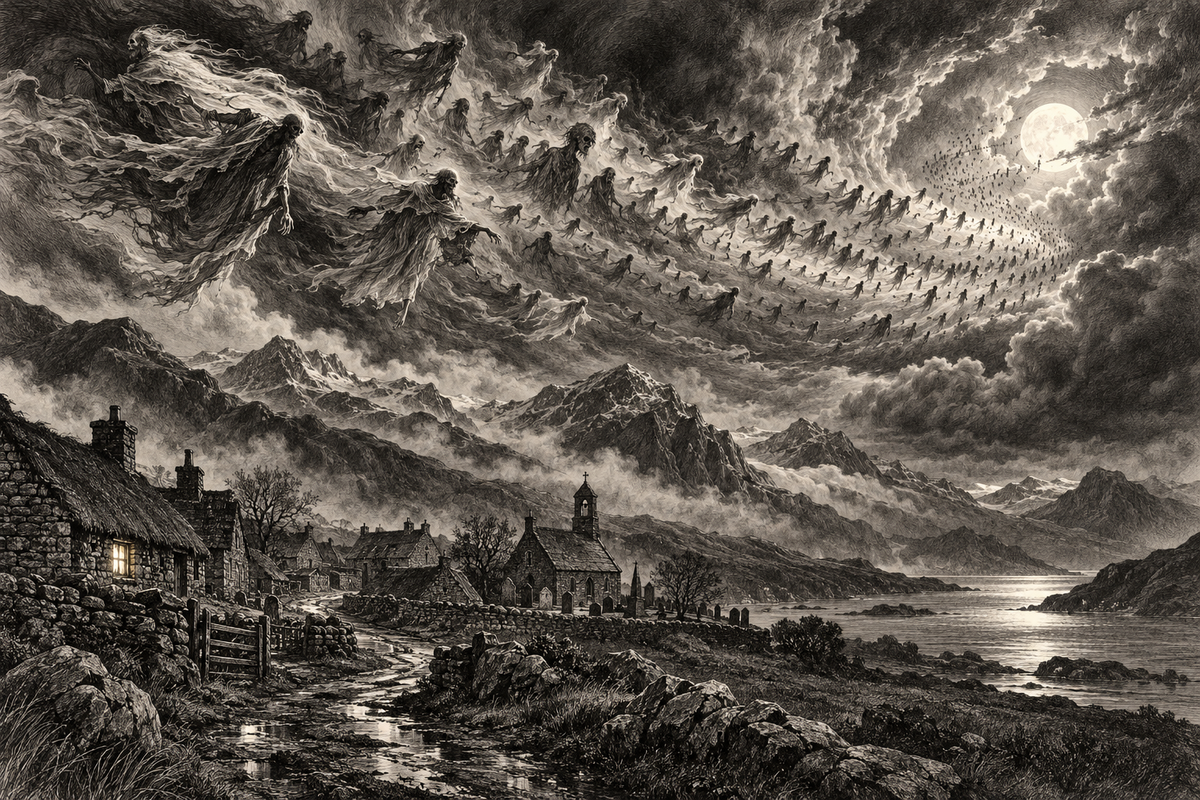
“There is a name for the company I mean. Sluagh na marbh, the Host of the Dead. You may also hear them called the unforgiven dead, particularly in the stories of our Highlands and Islands. Sluagh means a host, a crowd, a multitude. Keep that last word in your mind, for a single figure standing at a gate gives you very little idea of what these stories describe.
“Imagine the starlings above a winter field, with the whole gathering turning upon itself until the sky seems to fold. Now imagine that you can make out people in that gathering, and that the movement is carrying them towards your roof. There may be faces among them that you almost recognise. There may be nothing distinct enough for you to see, although you know perfectly well that something has passed.”
He paused, and the woman reached down to draw the youngest child closer to her knee. The lantern gave a faint metallic tick as it shifted upon its hook. Somewhere in the dark part of the room, a wet coat slipped from a peg and settled softly upon the floor.
“People did not always agree about what the host might be,” he continued. “Some said they were souls who could not come to rest until the wrongs of their lives had been answered for. Some spoke of them alongside the fairy host, and others kept the two apart. You will hear the saying that neither Heaven nor Hell would take them. It is a terrible saying, though it is not the only account the old people gave.
“The tales from Ireland have their own company of spirits and their own warnings about being carried away. They belong beside ours, but I would not make every Irish story into a Scottish one, or give every wandering spirit the same name. These particular accounts of the dead travelling together were told with great feeling in the Hebrides. People there had reason enough to pay attention to a night sky.
“They were not waiting for Samhain before they became afraid of the host. A traveller might fear it in another month, and a family might take precautions whenever someone lay near death. But on this night, when so many stories brought the otherworld close to the house, a person needed little encouragement to listen at the door. The weather alone could do a good deal of the telling.
“The host was often said to come from the west. Look towards that wall, if you wish, but keep your hands away from the fastening. In houses where someone was dying, the western doors and windows could be secured lest the spirits get at the soul as it left the body. Think of sitting beside your father's bed and hearing the frame begin to rattle. You would get up and see that it was properly closed.
“Elsewhere they would open a window to give the soul its passage. There were places in the Highlands where that was the proper kindness, and no one would have thanked you for interfering. Remember that before you tell another household it has remembered wrongly. A custom belonged to the people who kept it, and a dying person was loved just as deeply on either side of an open window.
“Here, in the tale I am going to tell you, the western shutter was kept closed. It belonged to a little house above the burn, where a woman lay dying on the last evening of October. Her name was Isobel, and her son had been sitting beside her since the cattle were brought in.”
The old man eased his stick against the hearthstone. For a moment he seemed to have forgotten the rest of us, and his eyes rested upon the black opening above the fire.
“The son was called Calum. He was young enough to believe that keeping awake would somehow keep his mother alive, so he had refused the neighbour's offer to sit in his place. The neighbour had gone home before dusk, leaving broth and a promise that she would return if he needed her. Her cottage stood beyond the burn, a short walk by the lower path.
“Isobel had been quiet for most of the afternoon. Now and again she asked whether the cow had been seen to, or whether the washing was still outside. Her son answered as though these things required his full attention. It helped him to have something ordinary to say while her breathing grew more difficult, and he made the answers longer than they needed to be.
“Her husband had been dead for eleven years. She had spoken his name in her sleep that morning, and Calum had turned towards the bed before he could stop himself. He remembered his father's boots beneath the settle and his habit of tapping the ashes from his pipe against the lintel. Grief can leave such small things very plainly in a boy's mind.
“The house had a narrow window looking west over the glen. Before the light failed, Isobel asked him whether he had made it fast. He said that he had, and she told him to feel the catch again. He was impatient with her for a moment, because he wanted her attention upon herself. Then he saw the effort it had cost her to ask, and went across the room to check it.
“After dark her breathing changed. Calum bent over her, waiting for the next breath, and found himself holding his own until hers returned. He knew then that he wanted somebody else in the house. He put a fresh peat upon the fire, told her he would fetch the neighbour, and took the lantern down from its nail beside the door.
“His mother caught his sleeve before he could straighten. Her hand had very little strength left in it, though he felt the pull through the wool. She asked him to stay a moment, and he waited while she gathered enough breath to speak. When the words came, they were much quieter than the rain against the wall.
“‘Whatever you hear out there, keep your mind upon where you are going.’
“He told himself afterwards that she had only meant the path and the water rising in the burn. At the time, he understood her well enough. He said that he would be back directly, and gently loosened her fingers from his sleeve.”
A draught moved beneath the cottage door, carrying a thin smell of rain into our room. One of the men stretched out his foot and pushed a folded sack more firmly against the gap. The old man followed the movement with his eyes, and went on speaking.
“The lower path was pale where water ran over the stones. Calum held the lantern away from his body and watched the small piece of ground it showed him. The neighbour's cottage ought to have been visible beyond the bend, but mist had come down along the burn. He could hear the water before he reached the bridge, and knew by the sound that it was running high.
“Halfway across, he heard somebody walking behind him. He stopped, and the sound continued for another pace or two. It was quite distinct from the rain, with the heavy uneven tread of a person whose boot had worn down at one heel. His father had walked like that after the accident that injured his leg. Calum knew the sound before he thought of its impossibility.
“He turned the lantern, and the mist showed him nothing beyond the wet rail of the bridge. There was a movement above it, where the darkness seemed to thicken between the houses and the hill. He might have taken it for low cloud if it had moved with the weather. Instead it crossed the glen against the wind, gathering as it came.
“Then a voice behind him said his mother's name. It was spoken with the small impatience his father had used when waiting for her at the door. Calum had not heard that voice for eleven years, yet he found himself about to answer it. His mouth was open before he remembered the fingers upon his sleeve.
“The lantern went out while he was turning. Whether rain reached the flame or the wind found its way through the glass, he could never afterwards say. He felt the rail beneath his left hand, cold and slippery with water. Above him there was a sound like a great flock passing, with something beneath it that might have been speech.
“The moon came clear for long enough to show him the slope beyond the burn. The darkness over it was full of movement. He saw garments lifting around bodies that had no footing, and faces carried past too quickly to remember. The whole company bent across the glen in a long curve, while its farther ranks disappeared into cloud. There seemed no end to those coming after.
“He tried to reach the far side of the bridge. His hand moved along the rail, but his feet no longer met the boards properly, and the lantern struck the wood beneath him. The next thing he remembered was seeing its broken glass far below. The burn had become a pale thread, and the roofs on either bank were sliding away beneath his feet.
“People who heard such stories sometimes supposed there must be wonder in travelling above the earth. Those said to have been taken by the host spoke more often of hardship. They were carried where they had no wish to go, and their bodies suffered for it. Some were returned so exhausted that their families scarcely knew what to do for them.
“Calum could feel hands or clothing dragging against his shoulders, though he could not turn enough to see what held him. Whenever he raised his head, the air drove tears across his face. At times he seemed to be passing through the gathered company. At others there was an open space beneath him, and he had to shut his eyes against the height.
“He saw a woman turn towards him, with her hair drawn across her mouth. For a moment she looked familiar, in the troubling way that a stranger may resemble someone whose funeral you have attended. Farther away, two companies appeared to be driving towards one another. Their movement reminded him of men advancing into a fight, and he felt himself pulled towards the place where they would meet.
“There were island stories of the host fighting battles in the air. On Barra, red colouring upon the rocks could be spoken of as the blood of those companies. Other stories told of their darts bringing death to animals and harm to people. There were even accounts of living men compelled to help them in their attacks. A captive might return with more to trouble him than the memory of being carried through the dark.
“What Calum saw next was his mother's house. He recognised the chimney first, and then the small yard where she had taught him to split kindling. The host had turned back across the glen, or perhaps it had never taken him as far as he imagined. Time and distance were things he could make little sense of afterwards. He knew only that he was being carried towards the western wall.
“Through a gap beside the shutter, he could see the firelight moving inside. His mother would be lying where he had left her, listening for his return. The thought brought such misery that he tried to call her, and discovered he could scarcely make a sound. Something beside his face was whispering her name with his father's voice.
“He reached out when he came against the wall. His hand found the shutter, and the wood was so familiar beneath his fingers that he nearly wept. He had painted it himself two summers before, leaving a rough place near the edge where the brush had shed its bristles. He felt that roughness now, and understood that he was trying to force his way through the window she had asked him to secure.
“Inside the house, something moved against the floor. He heard it through the wood, slowly approaching, followed by a pause that lasted until he thought he could bear no more. Then his mother spoke from the other side of the shutter. Her voice was weak enough that he had to press his ear close to hear it.
“‘Calum, come round to the door.’
“He tried to tell her that he could not. His fingers had caught painfully in the fastening, and whatever carried him was drawing him away from the wall. She spoke again, using his name just as she had when he was small and had gone where she could not see him. He put his free hand against the stones and tried to find something that would hold.
“He remembered the old iron ring beside the window, set there for a climbing rose that had long since died. He reached for it and missed, then caught it as his body was pulled sideways. The iron took the skin from his palm. He held it with both hands, while somewhere close to his ear his father's voice changed into a sound he had never heard from any living man.
“After that, he remembered very little. There was the scrape of his boots against stone, and the cold of the ground when he struck it. Someone was calling him from the door. He crawled towards the voice on his hands and knees, dragging the ruined lantern by the strap still caught about his wrist.”
The old man stopped and drew his right hand from beneath his coat. He opened it slowly upon his knee. The skin across the palm was pale and uneven, with a thick seam running towards the thumb. The eldest of the children looked from his hand to his face, but said nothing.
“The neighbour found them after a while,” he said. “She had seen the light go out along the path and had become uneasy when no one came to her door. Isobel was sitting against the bed, with her son upon the floor beside her. She had got back that far, though nobody could understand how she had managed it. He was still holding a piece of the lantern strap.
“She lived until the morning. There was time for him to sit beside her, and for the neighbour to put the house in order around them. He told his mother he was sorry for going, but she seemed more concerned that his hands should be washed and bound. When she died, he was near enough to hear her last breath. The western shutter remained fastened throughout.
“People made what they could of his account. Some thought he had fallen at the bridge and wandered home in a fever. Some listened closely and looked towards the hills when he described what had passed over them. He had no wish to argue with either sort. They had not been there, and he had too much difficulty sleeping to spend his days convincing them.
“He avoided the lower path after dark, even in good weather. There were evenings when the sound of birds settling upon a roof would make him leave the room. People who had known others said to be taken by the host understood that part of his trouble. They had seen how a person could be returned to the hearth and still be afraid of what might call him away.”
The fire had settled while he was speaking, and the room felt colder beyond the circle of chairs. The woman put another piece of peat upon the embers. For a little while it gave off a pale smoke, then caught along one edge and lit the old man's hand before he folded it beneath his coat.
“There is sorrow in the stories as well as fear,” he said. “The unforgiven dead were remembered as people whose wrongs had followed them beyond the grave. Some accounts allowed that their suffering might end when satisfaction had been made. Others left them wandering. I have thought often about that, and about the dreadful loneliness of a multitude in which no one can find rest.
“It helps me understand why people prayed for their dead, and why they might leave something upon a table for those they had loved. There is kindness in making a little room for remembrance. Yet the people who did these things could still rise from a chair and make certain that the western catch was holding. They knew that grief could make a person eager to hear a voice again.
“So have your cake, and let the children finish the apples. The fire is good, and there is company enough to see us through the evening. When it is time to go, walk together as far as your paths allow, and look after those whose houses stand apart. An old tale need not spoil the night, though you may find yourselves remembering it on the road.”
He leaned back, and somebody at last moved a cup upon the table. The little sounds of the room returned cautiously, with the scrape of a stool and the rustling of a skirt. Outside, the storm seemed to have drawn farther up the glen. We could hear water falling from the eaves, and for the first time that evening the dog beside the door lifted its head.
Then something moved along the western wall. It was a soft sound, easily mistaken for rain if it had not travelled so slowly from one end of the cottage to the other. The woman kept her hand upon the child's shoulder. Across the hearth, the old man sat very still, with his eyes fixed upon the shutter.
A man outside called Isobel's name. He spoke quietly, with a trace of impatience, as though he had been waiting for her to finish something before they set off together. The old man's hidden hand tightened beneath his coat. He bent towards the youngest child and spoke so softly that only those nearest him could hear.
“Stay where you are, lass. My mother has been dead these sixty years.”