Woodcock and Fieldfares in the November Frost
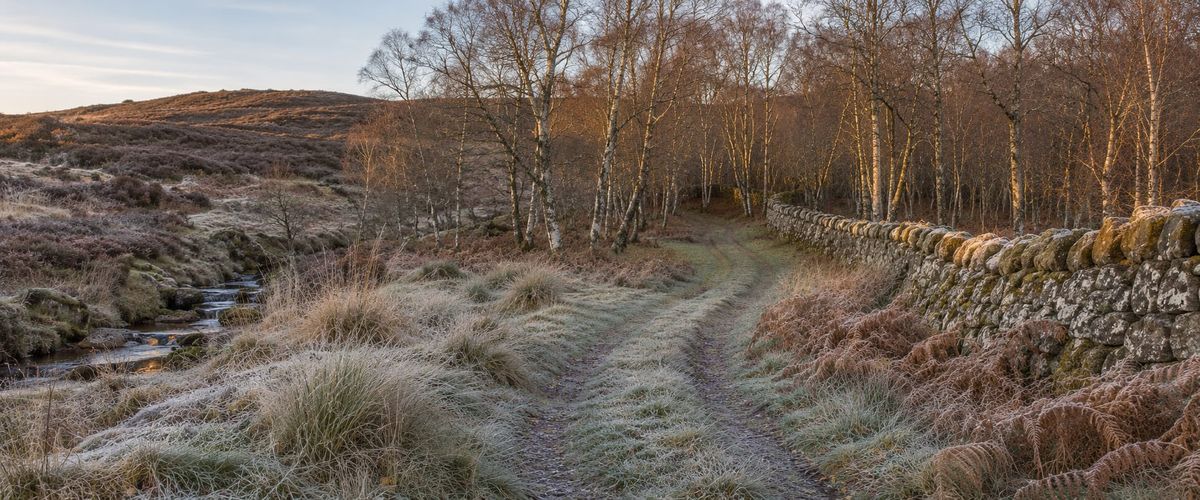
......first early morning walk of the season in real frost
The gate had frozen to its post. I had to put a shoulder to it, and when it gave, the latch rang out across the rough pasture. It was the middle of November and barely light. The low moor rose beyond the field in a long, shallow slope, with old heather showing through the frost and a dark belt of birches along its foot. In the cart ruts the ice was thin enough to see the mud through it. I found myself stepping round the first few puddles and then, for the small satisfaction of hearing them crack, through the rest.
There was frost on the top of the drystane dyke and on the side that faced the wood. On the other side the stones were dark and dry. A burn ran out from amongst the birches and passed under the track in a pipe. I could hear it a good way off. The water was running clear over little orange stones, and there were birch leaves caught in the grass along the bank, each with a rim of white. Where the burn had undercut a tuft, the roots hung down into the current and moved with it.
I followed the track into the birches. A few leaves still hung well up in the crowns, and one came spinning down and landed on the sleeve of my coat. Its underside was a duller yellow. I turned it over with a gloved finger and let it fall. Further in, the bracken had gone flat under its own weight. There was a smell of wet leaves where the path dipped. I stopped to see how best to get round a puddle that took up most of the track.
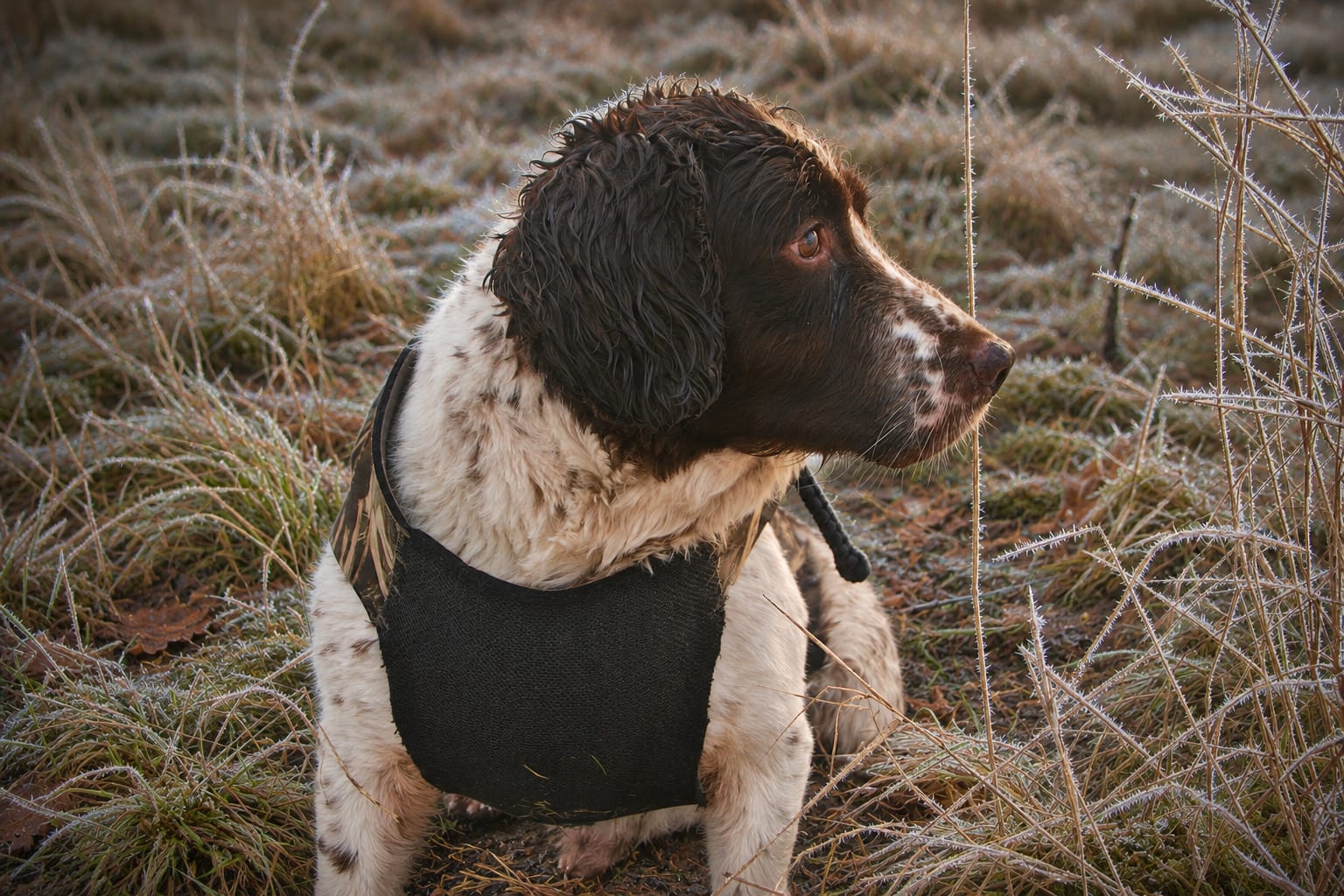
That was when the woodcock went up. It came out of the bracken a few steps ahead of me, almost level with my knees. There was a soft rush of wings and for a moment I could see the whole bird against a pale trunk, the long bill pointing down and the belly round under it. It flew low across the path, turned sharply between two birches and was away into thicker cover before I had thought to lift the binoculars. Bess, my springer spaniel, now aged as am I, looked up at me, as if she was lost in the memory of when I would have been carrying the shotgun, rather than the binoculars and notebook, and she would have been waiting for the command to go and retrieve the bird.
I stood for a while looking at the place it had come from. There was a fold in the dead bracken with wet birch leaves underneath. The leaves were all the colours I could remember seeing on the bird. I might have looked straight at it from the path. It had certainly had time to look at me.
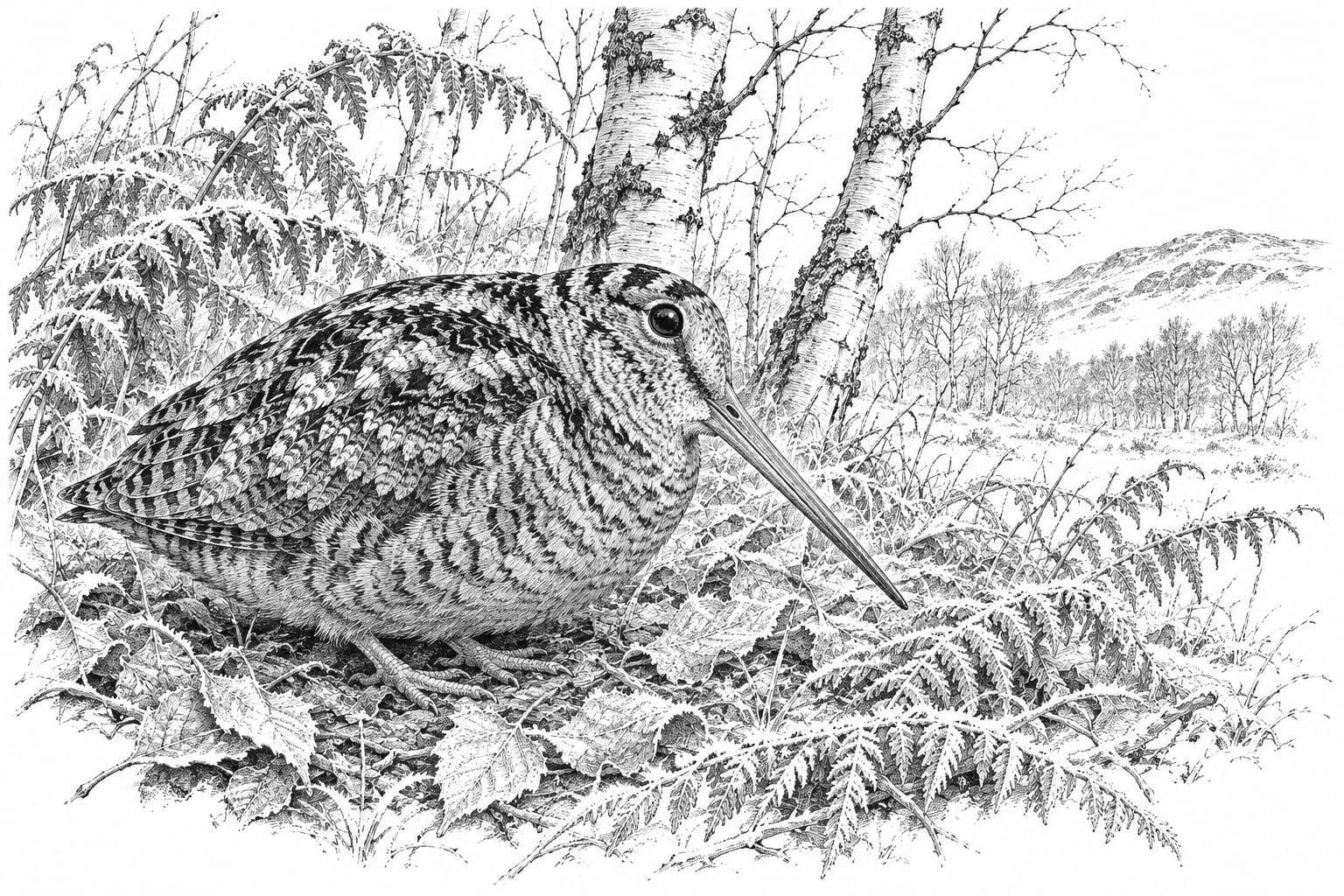
Woodcock among birch leaves and dead bracken
A woodcock’s eye is set so high and so far back that, with its head down and its bill in the ground, it can still see almost all the way round. Seen at rest, the dark bars run across the crown. Lower down, the lines break into the little angles and patches of colour you get in a bed of dead leaves. The long bill belongs to a wader, which is what a woodcock is. Here it puts that bill to work in soft earth, feeling for worms. Behind the bracken the ground was still damp enough to take the mark of a boot, though the grass out by the gate had been stiff with frost.
On winter nights woodcock often come out to feed in pasture and go back into cover by day. I had walked close to both places in the time it took my hands to warm up. Some woodcock breed in Scotland, and autumn brings in many more from northern and eastern Europe. There was nothing in my couple of seconds with this one to tell me where it had spent the summer. It could have hatched in a wood within walking distance or come here from beyond the Baltic.
The November full moon, due in 10 days here in Scotland, has a name in country lore, the woodcock moon. I like the idea of people turning a month’s worth of waiting into a name for a single night. In December 1907 the naturalist Robert Service, speaking at a meeting in Dumfries, was already doubtful that certain moonlit nights had been shown to favour the passage. He had seen woodcock coming in after daybreak in early November, high up and going fast. In windy weather he had watched them come in low and look for shelter along the hedges. More than a century later, researchers ringing woodcock in Hampshire reported arrivals in the dark of the new moon too. I thought of those high birds of Service’s and tried to put the one I’d just seen amongst them. I could still see the exact gap it had taken between the trees.
I came out of the wood where the dyke bent uphill and heard the fieldfares before I saw them. Chack-chack. I had been hearing the flocks of them flying over in the middle of the night this past few days. The Chackering came from the hawthorn over the wall, a bare, thorny bush that had kept most of its haws. One bird was right on top, looking out across the field. A second was down among the berries. It stretched sideways for one, swallowed it and had another before the bird on top had moved. Then a few more came over with the same dry chatter, and the bush seemed to have birds in it wherever I put the binoculars.
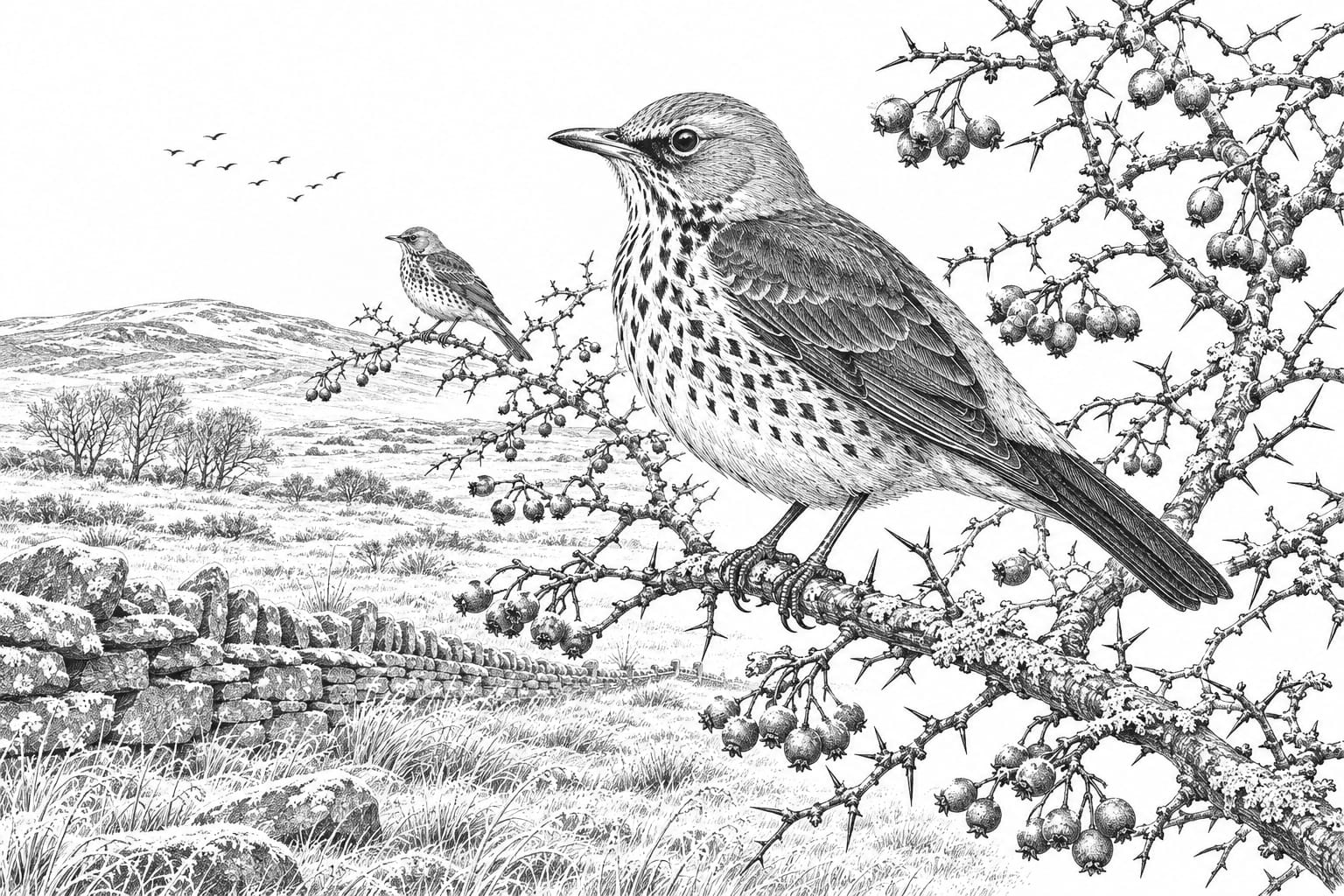
There was enough light by then to see the blue-grey of the head and the warm chestnut across the back. The breast of the nearest bird was buff at the throat, shading paler below, with little dark arrowheads that carried on down the sides. It turned on the twig and for a moment the grey rump showed very plainly above the dark tail. When the birds went down into the field, there was a quick flash of white from underneath their wings. A speckled breast will get you as far as thrush. The call and that grey rump will take you the rest of the way.
Most of the fieldfares we see here are winter visitors, some from Scandinavia and Finland, others from further east. How many reach Britain can depend on how well the trees have fruited nearer their breeding grounds. I hear this season has not been one of plenty for berries in their Baltic feeding grounds. In the field below the hawthorn, the birds spread out to feed. They ran a little way, stood upright and listened, then dipped forward to peck. There were worms and other invertebrates to be had where the ground was soft enough. The birds had picked a strip in the sun below the dyke. Where its shadow still lay across the grass, the white was as solid as it had been when I came through the gate.
Hillbird is an old Scots name for the fieldfare. In some districts it served for the mistle thrush as well. I can see how it might have done for either when there was a bird up on a thorn and you had a grey sky behind it. There’s another name of sorts in Chaucer. In the Parlement of Foules he calls it ‘the frosty feldefare’. He gives it a speaking part later in the poem, and the bird, which has been listening to a discussion about love, has some curt things to say about the price of pining for somebody who doesn’t care for you. I read that line about the frost differently after hearing a hedgeful of fieldfares on a cold morning. There’s a bit of the bird’s voice in it.
The flock rose while I was still leaning on the wall. The chacking carried down the slope for a little while after the birds had dropped out of sight. Close to my elbow, one of the haws had split, and a bead of thaw had gathered at the bottom of it. I watched it for much longer than it can have taken the woodcock to cross the path. In the end it fell, and by the time I straightened up the sun had reached the stones where I’d put my hands.
I went back by the burn. From the path I could see the place in the birches where the woodcock had flown and, over my shoulder, the bare top of the hawthorn. At the gate the first rut I’d stepped in held a few tilted shards with water between them. The latch lifted easily this time. I caught it in my palm and let the gate shut quietly.
Further reading
Bird identification and migration
BTO on woodcock · GWCT woodcock research · BTO on fieldfare · RSPB on fieldfare
The woodcock moon
Dumfriesshire and Galloway Natural History and Antiquarian Society, 1907 · BTO on Scotland’s winter visitors · GWCT ringing notes
The fieldfare in Scots and Middle English
Dictionaries of the Scots Language, ‘Hill’ · Chaucer, Parlement of Foules