The Nuckelavee
An Orcadian tale
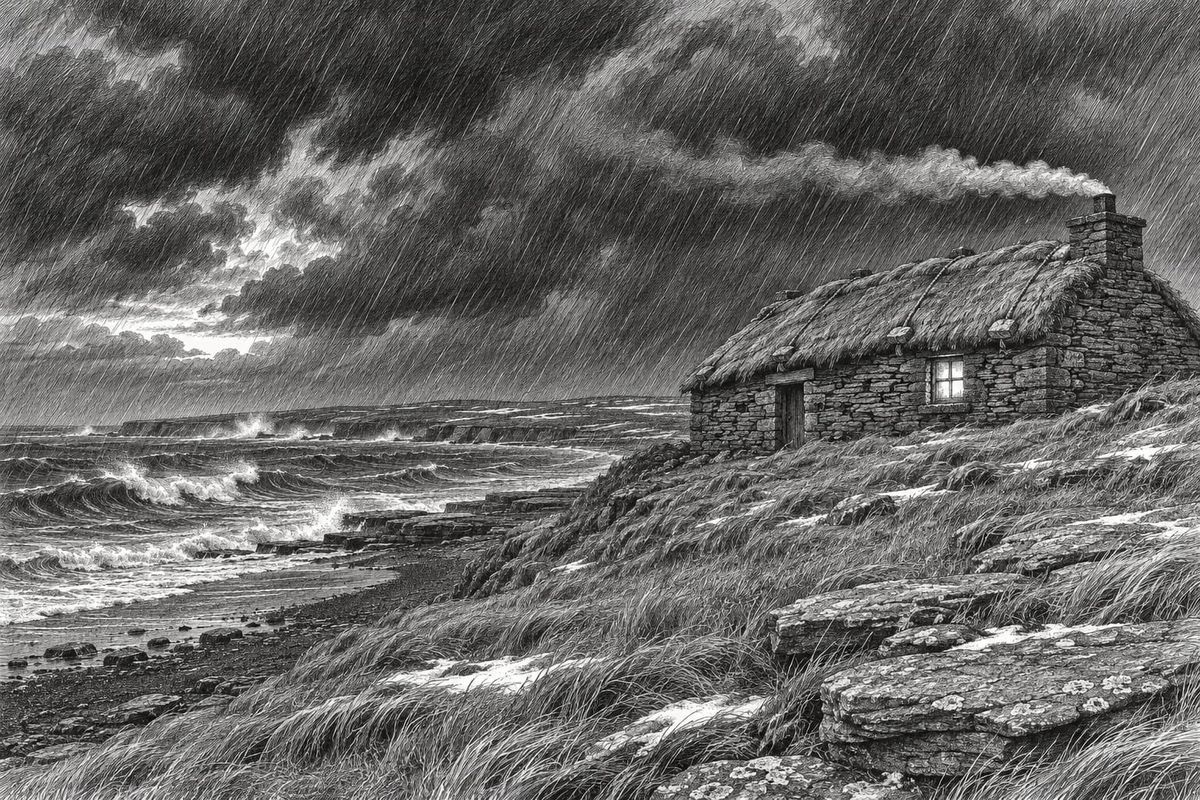
The first winter I heard the name spoken in Orkney, I was sitting so near the door that whenever someone came in I had to lift my feet and let them pass. It was the back end of 1854. There was a hard wind out of the west, and at the Bay of Skaill the sea was running white as far out as we could see. A little before dark I’d watched a gull turn inland over the brae. It was beating its wings fit to split itself, and all the while it went backwards.
The cottage stood a little above the shore, within sight of the mound the folk there called Skerrabra. Four winters earlier the sea had taken a good part of the turf off it, and there had been stonework underneath. You could go down in the daylight and see where the wall turned, as neatly as if somebody had laid it for a house that morning. A woman in the cottage told me her father used to cut across that mound on his way to the shore. All those years he’d been walking over somebody’s house. She found that a queer thing to think about. So did I.
The rain came shortly after dark. It hissed on the thatch and found a place to drip into a pan beside the meal chest. Half a dozen neighbouring households had come in for the evening, some to get out of the weather and some, I suspect, because they’d heard old Tammas was there. Two men shared the bench with a girl who was turning a stocking heel. A woman with a baby sat under the little window. Her mother had the other end of the bench and kept getting up to move the pan as the drip shifted. The children were wherever there was room for them. One had made himself a bed under the table with a rolled coat for a pillow.
Tammas had a short clay pipe and an old scar running from his thumb into the palm of his right hand. I knew how he’d got the scar. A fishhook had gone in while he was hauling a line, and he’d had to push the point through the skin himself before he could cut it free. He’d told me that in the time it took him to trim a wick. He could be difficult to draw out on other matters.
It was the girl with the stocking who got him started. She had been down at the shore that morning with her little brother. He’d come home crying because something had breathed at him from under a ledge.
“A selkie, most likely,” said one of the men.
“That’s what I told him,” she said. “Only it was the breath he was frightened of. He said it smelt bad.”
Her brother was sitting on the floor between her knees. At this he lifted his head.
“I could feel it on my face,” he said.
Tammas took the pipe out of his mouth.
“How close did you get?”
The boy put a hand up beside his cheek, the way you would if you were going to tell somebody a secret.
A lump of peat broke in the grate. A little rush of sparks ran up the back of the chimney, and when the light came down again, Tammas was looking at the boy’s sister.
“You did right to bring him away,” he said.
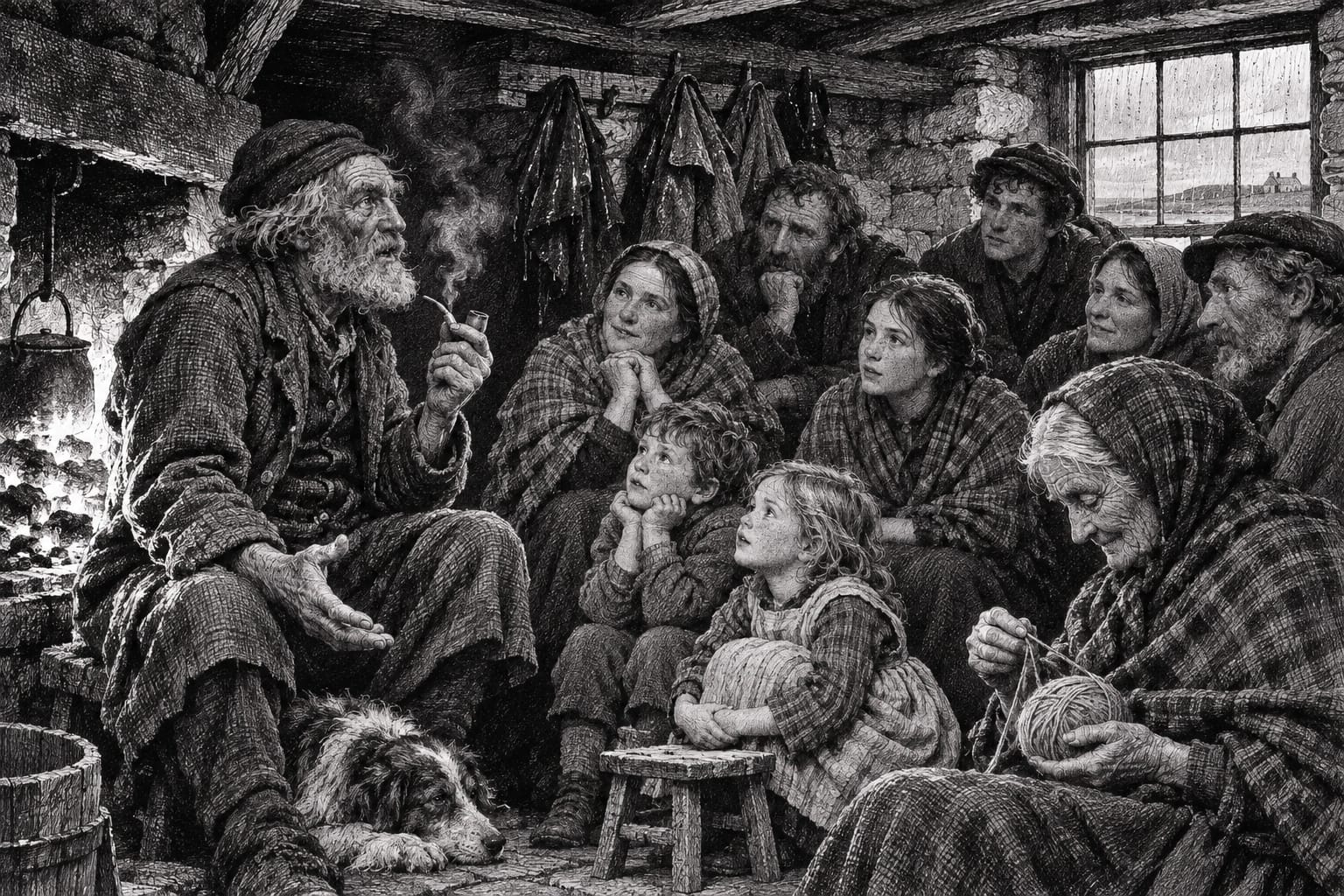
The girl laid her knitting down in her lap. “There’s something you know about it, then?”
Tammas looked towards the window and sat a while listening to the rain. It had got into the sill. A thin line of water was beginning to show on the stone.
“There was a fellow coming home along the shore,” he said at last. “A winter night, a fair while ago. I can tell you what happened to him, if it’s that you want.”
The old woman by the meal chest turned an ear to him. “Will you tell them his name this time?”
“Let them hear how he got home first.”
He set his pipe on the hearthstone. The boy under the table rolled over and put his chin on his coat. I could just see the soles of his feet.
“You’ll know the kind of road,” Tammas said. “Water either side, and a bit of dry going between. On his right there was the sea, and on his left there was a loch deep enough to drown a horse. There was a burn up ahead where water from the loch came out to the shore. He had crossed it in daylight often enough. Two good steps if you kept to the stones. It had rained the day before, though, and he hadn’t seen what the water had done since.”
The man had stayed late helping a neighbour shift a stone that had come down from a dyke. Afterwards there had been a bowl of kail and a piece of bread. He’d put the heel of the loaf in his pocket to take home to his daughter, who liked to soak it in the bottom of his porridge bowl. He thought of that, walking. The child would be asleep. In the morning she’d turn it over to see if he’d left her any crust.
There was no moon. There were stars enough to show the thin white margin where the sea broke on the stones. Farther off he could see a scatter of them in the loch. Once, a small bird got up out of the wrack at his feet and went away along the shore with a cry like a nail drawn out of wood. Then there was the sound of the water again, along with the grit under his boots.
He was well out on the narrow part when he saw something in the road.
It had the breadth of a horse, and he supposed at first there must be a man walking on the far side of it. He could see a head above the horse’s back and a movement below, which in a better light he would have taken for a coat. He called out. The thing kept coming. He moved a little left to give it room, and it moved left with him. That was when he noticed how far down the man’s hand hung. Once, as it swung forward, the knuckles passed in front of the horse’s knee.
“Would you have run?” Tammas asked.
The man on the bench who’d said it was a selkie scratched at a patch of salt on his sleeve. “I’d have gone back the way I came.”
“Aye,” said Tammas. “He considered it.”
The man on the road could hear the sea below him drawing the stones back downslope. He’d seen a cow go into the water off that shore. She was a strong beast, and they’d had two ropes on her, with four men pulling. He remembered how readily the sea had turned her over. Across the road was the loch, which shelved off almost from the grass. He could swim a little. In those boots and that coat he reckoned he’d have enough time to wish he’d stayed on the road.
He said a prayer. It came out in the voice he used at home for fear of waking the child.
Then he began to walk forward. The road was wider by perhaps a pace where it curved towards the loch. If he kept to the very edge, the horse might go by him. Even after he had seen the length of that arm, it seemed possible to him that there would be a moment when they would pass, and he could go on home. I’ve thought since about how much hope there is in that. He was still making room for another traveller.
The thing came out of a dip in the road, and he saw its eye.
It was low down, in the horse’s head, and it caught the light like a coal when you take the lid off the stove. Its mouth was open. At the corners the lips had drawn back far enough to show teeth deep in the jaw. The head above it was a man’s, or had been made on much the same plan, with a nose and a jut of bone about the eyes. It was so heavy that it wouldn’t stay straight. Every time a forefoot touched the road, the head fell a little towards one shoulder. On the next step it fell towards the other. The body underneath shifted to take the weight, all the way down into the shoulders of the horse.
In the bare crook of its elbow he could see the cords moving in the bend of the long arm and the dark pulse in the veins. It had no skin. At the back of each fetlock something thin opened and shut like the fin of a fish left on the stones. The place where you’d have looked for a seam between the two bodies was smooth and busy with muscle. He looked there twice. He wanted to find where the man ended, or where the horse could be got free.
“This was the Nuckelavee,” Tammas said. He gave the word no more weight than he had given the name of the loch. “God save us all,” said the old woman by the chest, very quietly. The young mother stopped rubbing the foot of her sleeping baby.
Out on the road, the smell came first. There was kelp in it, the sweet rot of the stuff after it has lain for days in a heap, and beneath that the smell of a pail in which a sick beast has bled. Then the horse’s head gave a little turn and its breath blew hot into the man’s face. His left eye watered. He wiped it because he needed both eyes to see where the edge of the road was.
There were folk who put the bad summers down to that breath, Tammas said. His mother had gone out one morning to look at the bere and found the crop lying grey almost to the dyke. It had been a good stand the day before. She came in with a few stalks and laid them across the table. His father took one up and rubbed the ear of it between finger and thumb. Tammas remembered him doing that for a long time, as if the grain might be there yet if only he went on rubbing. There were other years when the oats came through, and it was the beasts in the byre that took ill. Folk said the Sea Mither held the thing in the sea through the summer, when her strength was greatest. In winter the land had to depend on what water came out of the sky.
“Rain like this?” asked the girl.
Tammas nodded. “Fresh water. Remember that.”
Then he told us how the man’s boot slipped off the road.
The horse had come level with him. The long hand lifted. Up to that moment he’d borne the sight of the thing by looking at it in pieces, the eye, the leg, the hand. Now the whole weight of it leaned across the road after him, and the space in which he’d meant to pass came down to the width of his own shoulder. He shuffled sideways until his left heel found nothing. The boot went in. Water sprang up under the horse’s foreleg.
It screamed and shied away so sharply that a hoof struck sparks from a stone. The hand came down in the space the man had just left. He felt it pass his sleeve. Then there was a hoof in the ditch on the far side, and the whole beast had to put its weight on that leg to turn. It was the first ordinary difficulty the creature had had all night.
The man ran.
The loch water in his boot made a sucking noise every time he brought his foot down. He heard that quite plainly for the first few strides. Then he heard the hooves and could hear very little else. Once he caught his toe and went down on one hand. He’d picked stones out of that road with his father to make it easier to get a cart along. Now he could have blessed them for leaving one to catch hold of. He pulled himself up by it and went on. Behind him came a bellow that sounded like the sea roaring into a cave.
The burn was in a cut below the level of the road. He heard it before he saw it, a light running noise almost lost against the surf. He had used to take his daughter there when she was small. She liked to put a stalk of grass in above the stepping stones and watch for it to come out the other side. Sometimes it never did. He could see that little face waiting for the grass when he ought to have been looking at the ground in front of him.
The first stone was gone, or covered. The second showed only as a pale ripple. He left the road at a run, put his good boot down in the burn and snatched the other after it. Water filled both boots. There was so little of it between him and the thing on the bank that he could see a pebble roll where his foot had struck it.
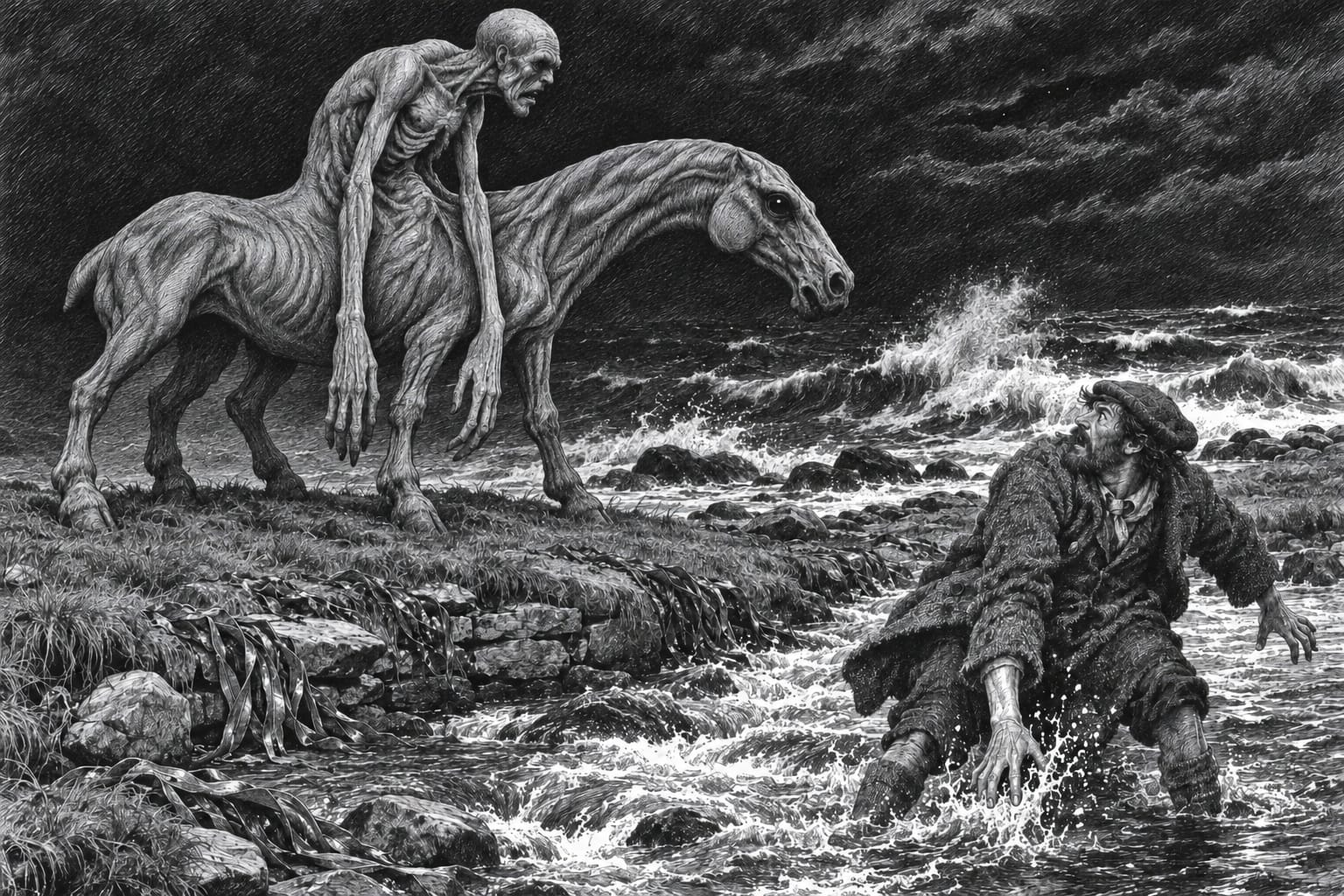
He could have stepped that last distance in daylight. As it was, he threw himself for the far bank, hands first, and his knees went into the wet grass. Something plucked the bonnet off his head. He felt his hair spring up with it. He pulled himself another yard on his elbows, then turned over, meaning to get his heels underneath him and keep going.
The horse was still on the other side. One forefoot hung over the water. He saw it come down almost to the surface and draw back again. Above it the fingers were opening and closing on his bonnet. His wife had knitted it before the child was born. There was a blue thread where she’d joined the crown, the only blue wool in the whole thing. That was the detail he would remember. He’d spent half the night trying to get a proper look at the creature. Across the burn he could see a thread his wife had put through a stitch years before.
The Nuckelavee dropped the bonnet at its feet. Then the great head lifted straight for the first time, and the noise that came out of it brought the man’s hands up over his ears. It seemed to go on after the mouth had closed. He put his forehead down in the grass. The next he knew of anything there was a grey light over the water and somebody beside him trying to unbutton his coat.
Here Tammas stopped. The younger woman by the window shifted the baby from one arm to the other. She looked down at the hand on the hearthstone.
“And the bread?” she asked.
“Still in my pocket,” he said. “It had got a little damp.”
There was a moment when none of us looked at him. The girl picked up her knitting, found the place where she had left it and drew the wool tight enough to bend a needle. The old woman got up and fetched Tammas a cup. He took it in both hands. There was hearth ash under his fingernails.
His daughter had come to the door in her bare feet that morning. She was cross because she’d been told to stay by the fire and somebody had shut the door on her. When she saw him, she asked for the bread. He had been glad of that. There was enough of it dry in the middle for her to eat. She sat on the end of the bed while he got warm, dropping crumbs into the blankets, and this was the part of the story that gave him most trouble to tell.
The boy who had smelled the breath under the ledge had been quiet all this while.
“Does it know where you live?” he asked.
Tammas finished what was in his cup. He looked at the boy a long time. “I’ve lived in the same house since,” he said.
The girl pulled her brother up beside her. He put his head under her arm, and she made room for it without looking down.
By and by a woman took the breadboard off the chest and went round with what was left of the oatcakes. There was a little talk about the weather and about whether the men could get along the shore in the morning to see to a boat. The man who had spoken of a selkie said he would go by the upper road. He had better boots for it, he said. Nobody asked to see his boots.
It was late when we rose to go. Tammas put his pipe in a pocket and stood with a hand on the mantel until he was sure of his legs. Outside, there was a good deal of water running off the thatch. I held the door for him and he went a step or two into the dark, turned his face up and let the rain fall on it. We stood there a while. Below us the sea was still taking stones out of the land. Close to the house, from a little runnel beside the path, came the sound of fresh water. Once I’d caught it I could follow it quite a way down the brae. I listened till Tammas touched my arm and we went on together.
A note on the tale
The encounter follows Walter Traill Dennison’s account of Tammas in “Orkney Folklore”, published in The Scottish Antiquary in December 1890. The gathering at the cottage, the people who listen and the details of Tammas’s family are imagined. The frame is set near Skara Brae, in the Bay of Skaill, four years after the storm of 1850 exposed the ancient stonework.
Dennison in The Scottish Antiquary • The Story of Skara Brae